
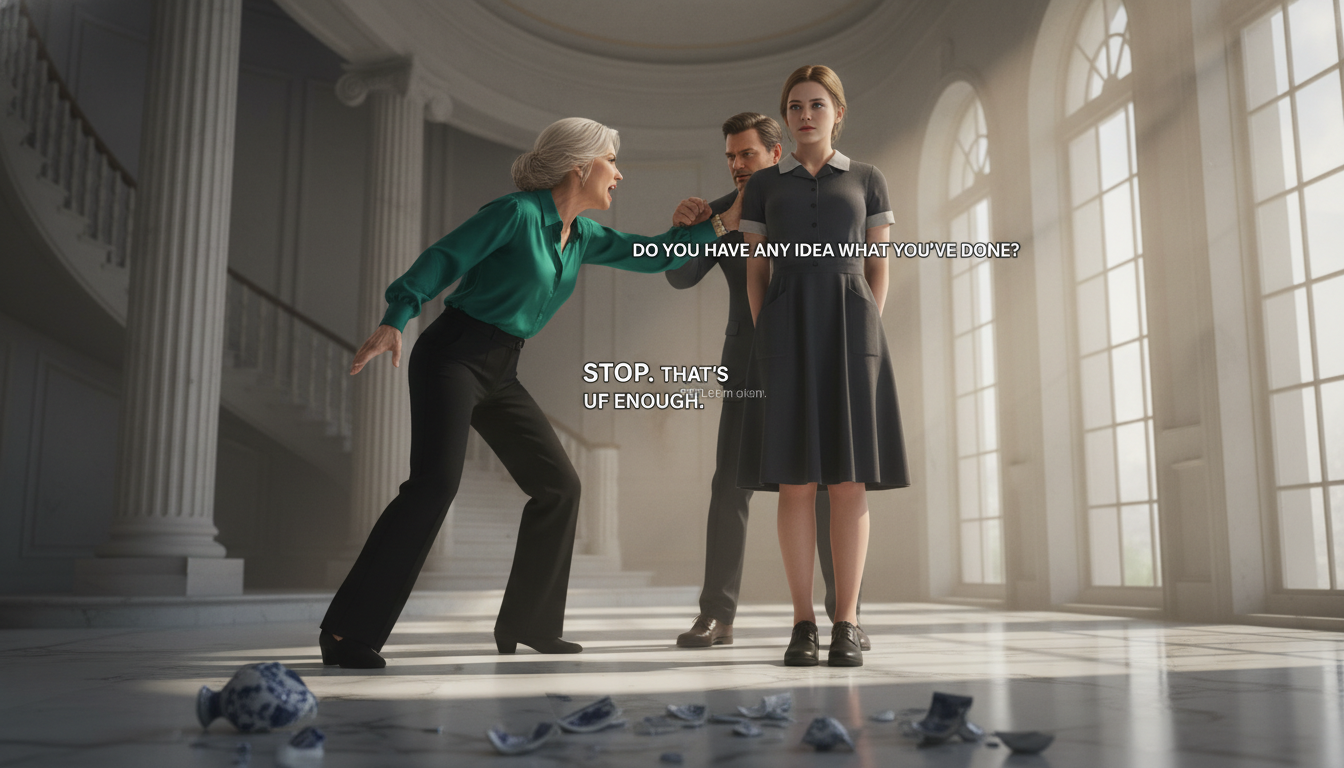
A priceless antique vase shattered — and the mistress raised her hand to strike the maid who broke it. But the one who stopped her wasn’t security or staff.
Anna had worked for the Hargrove family for three years. She knew the house by heart — every room, every rule, every fragile thing you never touched without asking.
The antique vase on the foyer shelf was one of those things.
It had been there the first day she arrived. Mrs. Hargrove had walked her past it and said, without looking at her, “That is a seventeenth-century Ming piece. It is not to be moved. It is not to be touched. It is to be dusted from a distance.”
Anna had nodded and remembered.
Three years, and she had never once touched it directly. She dusted the shelf below it with a long-handled cloth, worked her way carefully around it, gave it wide berth every single time.
Until today.
She had been distracted. That was all. She’d come in early because Mrs. Hargrove was hosting a luncheon and needed the foyer spotless by eleven. Anna had barely slept — her daughter had been running a fever since midnight, and she’d spent half the night counting degrees on a bathroom thermometer.
She was reaching for the shelf bracket above the vase when her elbow caught it.
Not hard. Just a nudge, the gentlest possible contact. But the vase rocked once, twice — and then it tipped.
The sound it made was not dramatic. It was almost quiet. A dry crack, then a cluster of smaller ones, like ice breaking on a shallow pond.
Anna stood very still and looked down.
The pieces lay across the marble floor. A hundred of them, maybe more. The painted rim. The curved body. A dragon motif, now in three separate shards.
“What did you do.”
It wasn’t a question. Mrs. Hargrove stood at the top of the entrance stairs, one hand gripping the banister, her face drained of color.
“Mrs. Hargrove — I’m so sorry, I —”
“Don’t.” She came down the stairs fast, her heels sharp against the stone. “Don’t apologize. Don’t speak. Do you have any idea what that was?”
Anna stepped back instinctively. “I know. I know how much —”
“You know nothing.” Mrs. Hargrove stopped two feet in front of her, her voice dropping into something cold and controlled. “That vase was appraised at four hundred thousand dollars. It was in this family for ninety years. My mother-in-law brought it from Europe personally.”
Anna felt the blood leave her face.
“Four hundred thousand.” Mrs. Hargrove repeated it slowly, watching Anna’s expression change. “Do you understand what that means? Do you have any comprehension of how many years you would have to work — you, specifically — to replace that? Your entire life wouldn’t cover it. Your children’s lives.”
“I didn’t mean —”
“You never mean to.” She took one step closer. “That’s the problem, isn’t it? You people never mean to. You just break things and walk away.”
Anna’s jaw tightened. She did not speak.
“Look at me when I’m talking to you.” Mrs. Hargrove’s hand came up.
It was not a slow movement. It was quick and practiced, the automatic gesture of someone who had done it before, or had always believed she could.
It didn’t land.
A hand — a man’s hand — closed around Mrs. Hargrove’s wrist midair.
“Katherine.”
Mr. Hargrove had come through the side door without either of them hearing him. He stood just behind his wife, holding her arm at a complete stop, his grip not rough but absolute.
“Stop,” he said. “That’s enough.”
Mrs. Hargrove spun toward him. “Did you see what she did? Did you see —”
“I saw.” His voice was quiet. “I saw the vase. And I see what you were about to do.”
He let go of her wrist and stepped around her, facing Anna directly. His expression was unreadable, but there was something careful and deliberate in the way he moved — like a man choosing his words before he opened his mouth.
“Are you all right, Anna?”
She blinked. No one in this house had asked her that in three years.
“Yes,” she said. “I’m sorry about the vase, Mr. Hargrove. I wasn’t paying attention. I’ll — whatever needs to happen, I’ll accept it.”
“Nothing needs to happen right now,” he said. He looked at his wife. “Except for you to go upstairs.”
“Excuse me?” Mrs. Hargrove stared at him. “That vase was —”
“I know what it was. I was there when we bought it.” He didn’t raise his voice. “Go upstairs, Katherine. I’ll be up in a few minutes.”
Something passed across her face — surprise, then fury, then something quieter and more dangerous. She looked at Anna one last time, turned, and walked back up the stairs without another word.
They stood in silence until they heard the bedroom door close.
Mr. Hargrove crouched down and began gathering the larger shards of the vase with his bare hands. Anna immediately knelt to help him.
“You don’t have to do that,” she said.
“I know.” He picked up the painted rim, examined it for a moment, set it aside. “It was insured. Fully. This won’t cost you anything.”
Anna looked at him. “That’s not —”
“It’s not about the money,” he said. “I know. Neither is this.” He kept collecting pieces, methodical and unhurried. “My wife grew up with a great deal and lost most of it. The objects she held onto are the ones that still have her family’s names on them. She’s never been able to separate their value from her own.”
“That’s not an excuse for what she was about to do,” Anna said, quietly but clearly.
He paused. Then he looked at her directly. “No. It isn’t.”
He stood, placed the fragments carefully on the shelf where the vase had stood, and took a breath.
“I’d like to offer you a raise,” he said. “Not as compensation. You didn’t do anything wrong that warrants compensation. As an overdue correction. I should have done it a year ago.”
Anna was quiet for a moment. “I need to think about whether I want to keep working here.”
“That’s fair,” he said. “I’ll have Patricia reach out on Monday. Whatever you decide.” He picked up his briefcase from where he’d left it by the door. “Take the rest of the day. Your daughter’s sick, isn’t she? I heard you mention it to Rosa last week.”
She stared at him. “How did you —”
“I listen more than my wife thinks I do.” He opened the door. “Go home, Anna.”
She stood alone in the foyer for a moment, surrounded by the broken pieces of something worth more money than she’d ever see in one place.
She took off her work apron, folded it carefully, and laid it on the entry table.
Then she picked up her bag and walked out the front door — a door she had only ever used for arrivals.
By Monday morning, two things had happened.
Anna had called Patricia and given her conditions: a formal employment contract, a written conduct policy signed by both Hargroves, and a twenty-two percent raise. Non-negotiable.
Patricia had called back in four hours. Mr. Hargrove had agreed to all three.
The second thing was that Mrs. Hargrove, for the first time in three years, was the one who didn’t show her face when Anna arrived.
She stayed upstairs until noon.
When she finally came down and found Anna in the kitchen, she stopped in the doorway. She didn’t speak.
Anna looked up and held her gaze without looking away.
Mrs. Hargrove left the room.
It wasn’t an apology. But in that house, in that moment, it was as close as power ever came to admitting it had been wrong — and Anna knew the difference between someone backing down and someone being broken.
She had the contract in her bag. That was enough.

Related Posts