A dying father summoned his greedy children to his hospital bed… But the stranger who walked through the door took everything from them.
The hospital room smelled like antiseptic and old regrets.
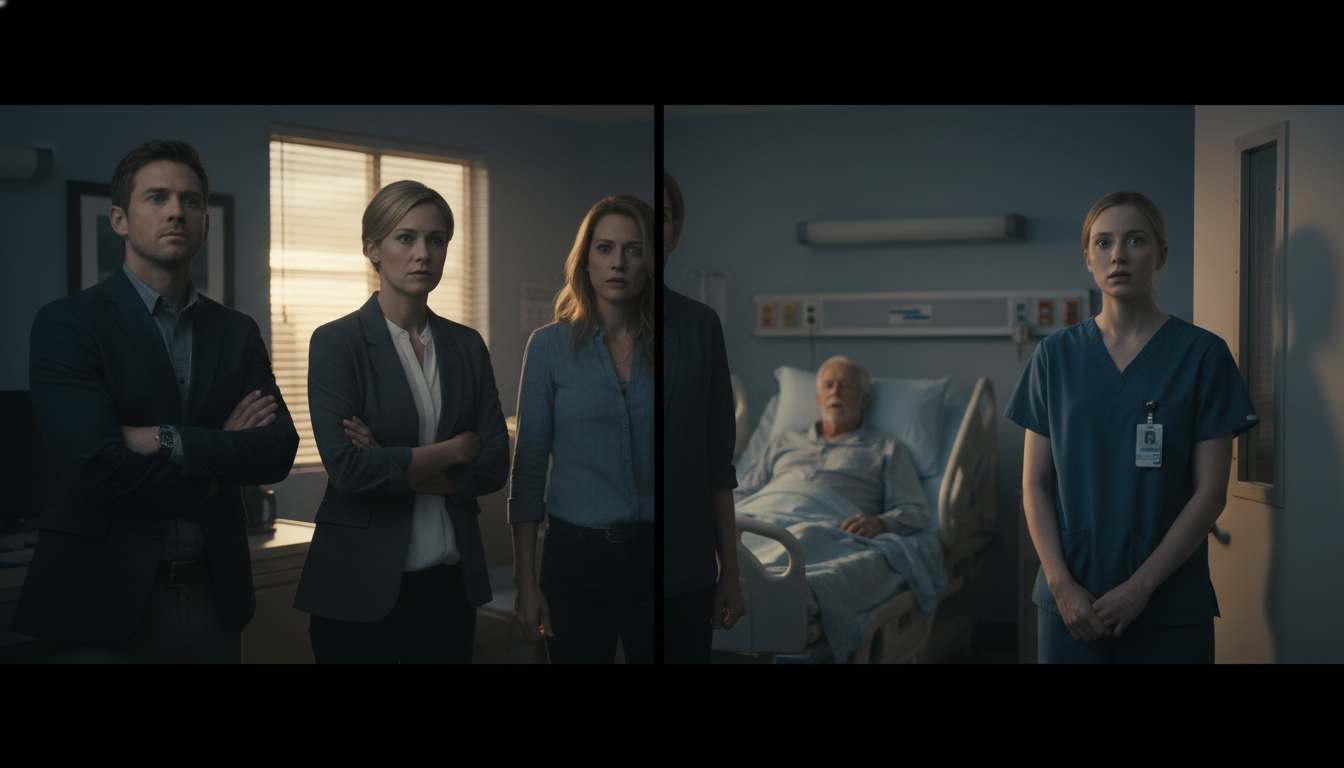
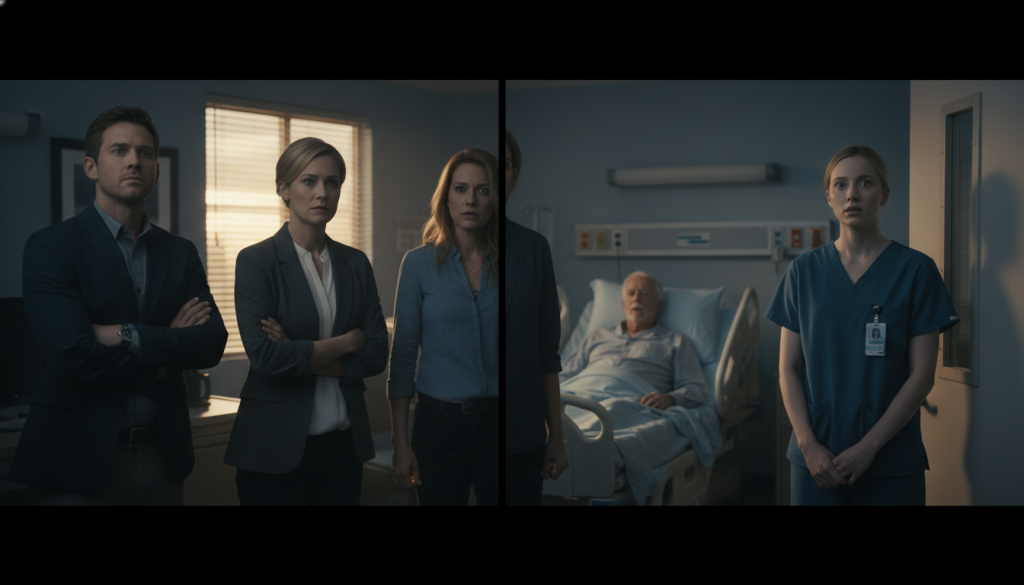
Harold Whitmore, seventy-four years old, lay still beneath a thin cotton blanket, eyes shut, oxygen tube taped under his nose. The monitor beside him beeped steadily. His four children stood clustered around the bed — not holding his hand, not praying — arguing.
“The house is worth at least eight hundred thousand,” Marcus said, keeping his voice low. “Split four ways is two hundred each. That’s fair.”
“It’s not fair,” his sister Diane cut back. “I’ve been the one calling the doctors. I’ve been handling his insurance. I deserve more.”
“You live twenty minutes away,” their brother Dennis said. “That’s not sacrifice, that’s geography.”
The youngest, Patricia, stood at the foot of the bed scrolling on her phone. “Can we just figure out the investment accounts first? Those are liquid. Easier to divide.”
“Dad’s not even dead yet,” Marcus said.
“He’s on a ventilator. He can’t hear us.”
He could hear every word.
Harold had been listening for eleven minutes. Not because he was unconscious — but because he wanted to know. He’d been suspicious for years. Birthdays forgotten. Calls that never came. Visits that happened only when paperwork needed signing. He’d told his doctor two weeks ago: I want to know what they really want. Give me one last look.
His doctor had been reluctant. Harold had been insistent.
So now he lay there — breathing fine, vitals stable, a mild sedative just enough to keep him appearing groggy — and he listened to his legacy being divided like a pizza.
“The cabin in Vermont,” Dennis said. “I’ve always wanted that.”
“You want it because it appraises at four hundred thousand,” Diane snapped.
“Is that wrong?”
“The art collection alone—” Patricia started.
“The art collection is mine,” Marcus said. “He told me personally he wanted me to have it.”
“He told you that when you were twelve.”
“A promise is a promise.”
Harold opened his eyes.
The room went silent. Four heads turned toward him. Four faces rearranged themselves — guilt draped over greed, concern plastered over calculation.
“Dad,” Diane said softly, stepping forward. “We’re here. We’ve been here all night.”
You’ve been here forty minutes, he thought.
He looked at each of them. Marcus, who’d borrowed money four times and repaid it zero times. Dennis, who’d missed Harold’s heart surgery because of a conference in Vegas. Diane, who handled his insurance — yes — and had twice tried to convince him to downgrade his care plan. Patricia, who was already on her phone again, right now, even as he watched her.
Harold pulled the oxygen tube from under his nose. His voice came out low and rough, but clear.
“I heard you.”
No one spoke.
“All of it.” He looked at Marcus first. “The house.” Then Dennis. “The cabin.” Diane. “The art.” Patricia. “The accounts.”
Patricia put her phone in her pocket.
“We weren’t—” Marcus started.
“Don’t.” Harold’s voice didn’t rise. It didn’t need to. “I’m not angry. I’m just done pretending I don’t know who you are.”
He pressed the call button on his bed rail. Once.
“Dad, we love you,” Diane said quickly. “We were just talking. People talk.”
“People who love you don’t talk like that over a hospital bed.”
“You’re being unfair.”
“I’ve been unfair my whole life,” Harold said. “I gave and gave and told myself it was love. Paid Marcus’s debts. Bought Dennis’s car. Paid for your divorce lawyer, Diane. Paid for Patricia’s apartment when she quit her job. Every time I thought — next time they’ll show up. Next time they’ll call just to talk, not just to need something.”
The monitor beeped.
“Next time never came.”
A knock at the door. Soft. Hesitant.
The door opened.
A young woman stepped in. Mid-twenties. She wore scrubs, but not hospital scrubs — the kind you wear when you’ve come straight from work at a care facility. Her hair was pulled back and she had the careful, unhurried movement of someone used to sick rooms.
Her name was Carla Reyes. She’d been Harold’s home aide for three years.
She stopped when she saw all four children. “I’m sorry — I didn’t know everyone was here. I can come back.”
“Stay,” Harold said.
She stayed.
“Who is this?” Marcus asked.
“This is Carla.”
“His nurse?” Diane said, with a tone that made nurse sound like a diminishment.
“His aide,” Harold said. “She came every morning for three years. Made my breakfast. Drove me to chemo. Sat with me when I couldn’t sleep because I was scared.” He paused. “She never asked me for anything.”
“Dad—” Dennis started.
“She called me on my birthday,” Harold said. “Not to ask about the will. Just to say happy birthday. She stayed two hours on a Tuesday because I wanted to show her a documentary about migratory birds. She cried at the end.”
Carla looked at the floor. Her jaw was tight.
“I had my attorney here this morning,” Harold continued. “Before any of you arrived. I signed new documents.”
The room changed temperature.
“You’re not serious,” Marcus said.
“The house. The cabin. The investment accounts. The art collection. All of it goes to Carla. In full. With the provision that she use the main estate proceeds to fund a senior care scholarship in her name, if she chooses to.” Harold looked at his son. “She chose to. Already.”
“This is insane,” Diane said. “You can’t do this. You were sedated—”
“I was not sedated,” Harold said evenly. “My doctor will confirm I was cognitively present and voluntarily signed. And before you say undue influence — my attorney anticipated that. There’s a video record of the signing and a psychiatric evaluation completed this morning.”
Silence.
“You set this up,” Dennis said. It wasn’t a question.
“I wanted to know,” Harold said simply. “Now I know.”
Marcus looked at Carla. His face had gone cold. “You manipulated him.”
Carla finally looked up. Her voice was quiet and steady. “I showed up.”
“That’s not—”
“For three years,” she said. “I showed up. I didn’t know about any will. I didn’t know he was doing this today. I came because his chart said he was admitted last night and I was worried.”
“She drove forty minutes in traffic,” Harold said. “On her day off.”
Diane turned to her father. Her voice cracked — not with grief, Harold noticed. With the specific panic of a person watching money leave a room.
“Dad. We’re your family.”
“I know,” Harold said.
“You can’t just—”
“I just did.”
Marcus grabbed his coat from the chair. “We’ll contest it.”
“You’re welcome to try,” Harold said. “The attorney’s name is Richard Fallon. He’s been doing estate law for thirty years and he’s very thorough.” He looked at his son. “He’s also the one who’s been documenting every loan I’ve given you since 2009. That’ll come up in discovery.”
Marcus said nothing.
Dennis walked out without a word. Patricia followed, not looking at anyone. Diane lingered, hand on the door.
“I did love you,” she said finally. “Whatever you think.”
“I think you did,” Harold said. “In the way you knew how. It just wasn’t enough.”
She left.
The door swung shut.
Harold exhaled. Carla stood at the foot of his bed, hands clasped in front of her, eyes wet.
“You didn’t have to do this,” she said.
“No,” he agreed. “I wanted to.”
“I don’t know what to say.”
“Don’t say anything. Sit down.” He gestured to the chair beside the bed — the one none of his children had used. “Tell me about the documentary you watched last week. The one about the Arctic.”
Carla pulled the chair over and sat down.
“It was about narwhals,” she said.
“Were there good narwhals?”
“They were all good narwhals.”
Harold smiled. For the first time in years, he felt light — not sick, not tired, not forgotten. Just light.
The monitor beeped.The door stayed closed.

Related Posts