
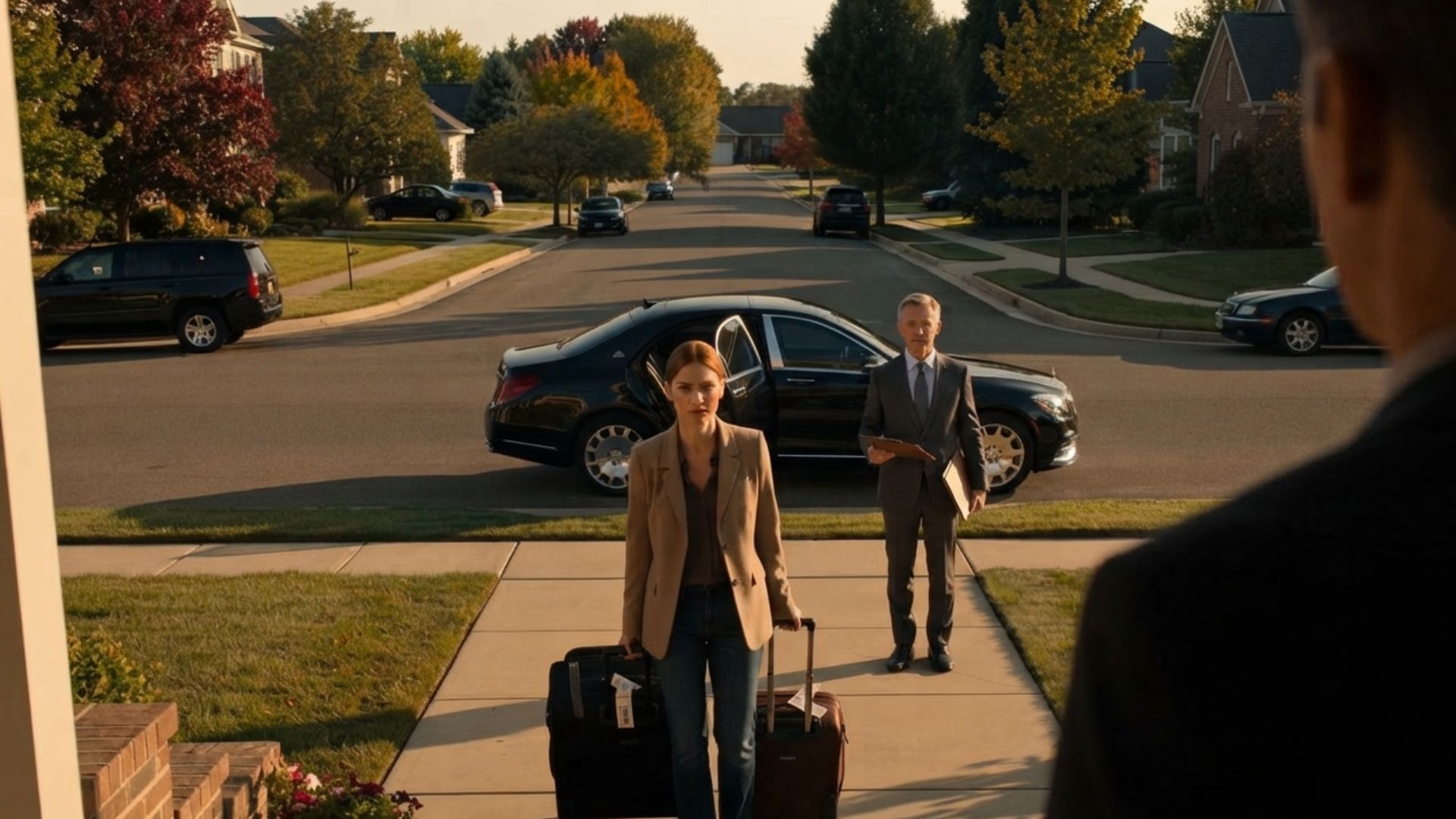
He threw his wife’s suitcase out the door and told her she’d lost everything — until a lawyer stepped out of a $200,000 car and asked whose house it really was.
The suitcase hit the driveway before Claire even reached the front steps.
“Get out,” Daniel said from the doorway. He didn’t raise his voice. That was always the worst part — he never had to. “You’re deprived of everything. This is now just my house. Mine and hers.”
Meredith appeared behind him, her hand resting on his shoulder like she’d already moved in. She had, in a way. Three months’ worth of “overnight stays” had made sure of that.
Claire looked at the suitcase. One bag. Twelve years of marriage, condensed into a rolling carry-on she hadn’t even packed herself.
“Daniel—”
“Don’t.” He stepped back inside. “The code’s already changed. Don’t embarrass yourself.”
The door shut. The dead bolt clicked.
Claire stood on the driveway of the house she had bought — with her inheritance, her credit, her name on the original deed — and felt the quiet of the neighborhood fold in around her.
She didn’t cry. She was too tired to cry.
She picked up the suitcase handle, turned toward the street, and stopped.
A black car was parked at the curb. Not a regular car. A $220,000 Bentley Continental, matte obsidian, with a driver still behind the wheel. The rear door opened and a man in a charcoal suit stepped out. Fifties. Silver at the temples. A leather folder tucked under one arm.
He looked at Claire, then at the house, then back at Claire.
“Mrs. Claire Whitmore?” he said.
“Yes.”
He extended his hand. “Richard Hale. Hale and Associates. I represent your late uncle’s estate.” He paused. “We’ve been trying to reach you for six weeks.”
Claire stared at him. “My uncle passed two months ago. I thought that was — I thought that was handled.”
“It was.” He opened the folder. “In your favor. Considerably.”
The front door opened again. Daniel, curious now, leaned against the frame. Meredith stood just behind him, wine glass in hand.
“Who is that?” Daniel called.
Richard Hale turned. He held up the folder.
“The question,” he said, his voice carrying perfectly across the driveway, “is who will be leaving this house.”
Silence.
Daniel laughed, short and sharp. “That’s my house. My name’s on the mortgage.”
“Your name is on the mortgage,” Hale said, walking forward slowly. “Her name is on the deed. And has been since the property was transferred as collateral for an estate loan your wife co-signed in 2019.” He stopped at the base of the steps. “The mortgage — your mortgage — was funded by that same estate loan. Which means the underlying asset has always been hers.”
“That’s not—” Daniel shook his head. “That’s not how that works.”
“I’ve had three real estate attorneys confirm it works exactly that way.” Hale offered the folder. “Would you like to call a fourth?”
Daniel didn’t take it.
Claire walked up the steps. Slowly. Deliberately. She stopped two feet from Daniel and looked at him the way she hadn’t allowed herself to in years — clearly, without hoping for anything back.
“The locks are changed,” she said quietly.
“Yeah.” His voice had lost its edge.
“Change them back.”
He didn’t move.
“Daniel.” Her voice was still calm. “I’m not asking.”
Meredith touched his arm. “Daniel, what is she—”
“Not now,” he said. To Meredith. Not to Claire.
That was the moment Claire knew it was over — not the suitcase, not the door slamming, not twelve years of slow erosion. It was this: the way he spoke to the woman he’d chosen the way he used to speak to her. Like she was inconvenient. Like she was an obstacle to his comfort.
She almost felt sorry for Meredith.
Almost.
“I’ll need a check-in by five PM,” Hale said from behind her. “If you want to discuss voluntary vacating, I’d strongly recommend doing it before my client files the removal order with the county.”
“Removal order,” Daniel repeated. Like the words were in a language he didn’t speak.
“Standard procedure when a non-titled occupant refuses to vacate a property.” Hale clicked his pen. “It goes on record. Affects future lease applications. Mortgage approvals. Background checks.” He let that settle. “Up to you.”
The wine glass in Meredith’s hand tilted. A thin red line ran down the stem onto her fingers.
“Daniel,” she said. Her voice was different now. Smaller. “Do you — do you own this house or not?”
He didn’t answer.
That was also an answer.
Claire reached past him — past both of them — and pressed her palm flat against the door she had chosen, in the neighborhood she had picked, on the street she had driven down a thousand times thinking it was home.
“I’m going to need a locksmith by three,” she said to Hale. “And I’ll need a list of what they took from the master bedroom.”
“Already prepared,” he said, pulling a second document from the folder. “Inventory was conducted this morning.”
She nodded. Professional. Steady.
“You can’t do this,” Daniel said. The anger was back, but it was thin now — the kind of anger that knows it’s already lost. “You can’t just walk back in here like—”
“Like it’s my house?” She tilted her head. “Watch me.”
She pushed the door open and walked inside.
The locks were changed back by four. By four-thirty, Daniel had moved two suitcases to his car — not hers. His. The cheap rolling ones he’d bought in 2018 for a business trip he’d taken alone and come back from quieter than when he left.
Meredith left without her wine glass.
Richard Hale sat in the kitchen while Claire made coffee, going through the estate documents. The inheritance was larger than she’d known. Her uncle — a quiet man who’d built three industrial properties in the Pacific Northwest — had left her everything, including a controlling interest in a commercial real estate holding company.
“He tried to reach you,” Hale said. “Before he passed.”
“I know.” She wrapped both hands around the mug. “I was — I was dealing with things here. I kept thinking I’d call him next week.”
There was a pause.
“He knew,” Hale said. “He left a letter, if you want it.”
She nodded. Her throat was tight.
“He said—” Hale found the page. “He said, ‘She always deserved better than the life she talked herself into. Maybe this will make the next one easier to walk into.'”
Claire put the mug down.
She pressed her fingers against the kitchen counter — the tile she’d picked out, the granite edge she’d chosen, the cabinet handles she’d replaced herself one Saturday afternoon while Daniel was wherever Daniel went on Saturdays.
She didn’t cry then either.
But it was a different kind of not crying. The kind that comes from being full instead of empty.
Outside, Daniel’s car reversed out of the driveway and disappeared around the corner.
She watched it go through the window above the sink. Then she picked up the mug again, turned to Hale, and said, “Where do I sign?”
He smiled — small, professional, warm. “Page four.”
She signed on page four.
Then page seven.
Then the last page, where her name went on a line marked SOLE BENEFICIARY.
She dated it. Capped the pen. Set it down.
“Welcome home, Mrs. Whitmore,” Hale said.
“Just Claire,” she said.
He nodded. “Welcome home, Claire.” She stood in her kitchen, in her house, on the street she’d chosen — and for the first time in longer than she could accurately remember, nothing needed to be different than it was.

Related Posts