He came home to an empty house, ransacked rooms, and silence where his wife should have been… But the 911 call that followed exposed a secret no one saw coming.
The drive home was ordinary. Michael hummed to the radio, loosened his tie at the first stoplight, and thought about what Jane might be making for dinner.
He turned onto Maple Creek Drive at 6:47 PM.
The front door was already open.
Not wide open — just cracked, the way it looked when someone left in a hurry. Michael sat in the driveway for a moment, engine idling, staring at that inch of darkness between the door and the frame.
He told himself it was nothing.
He was wrong.
“Jane?”
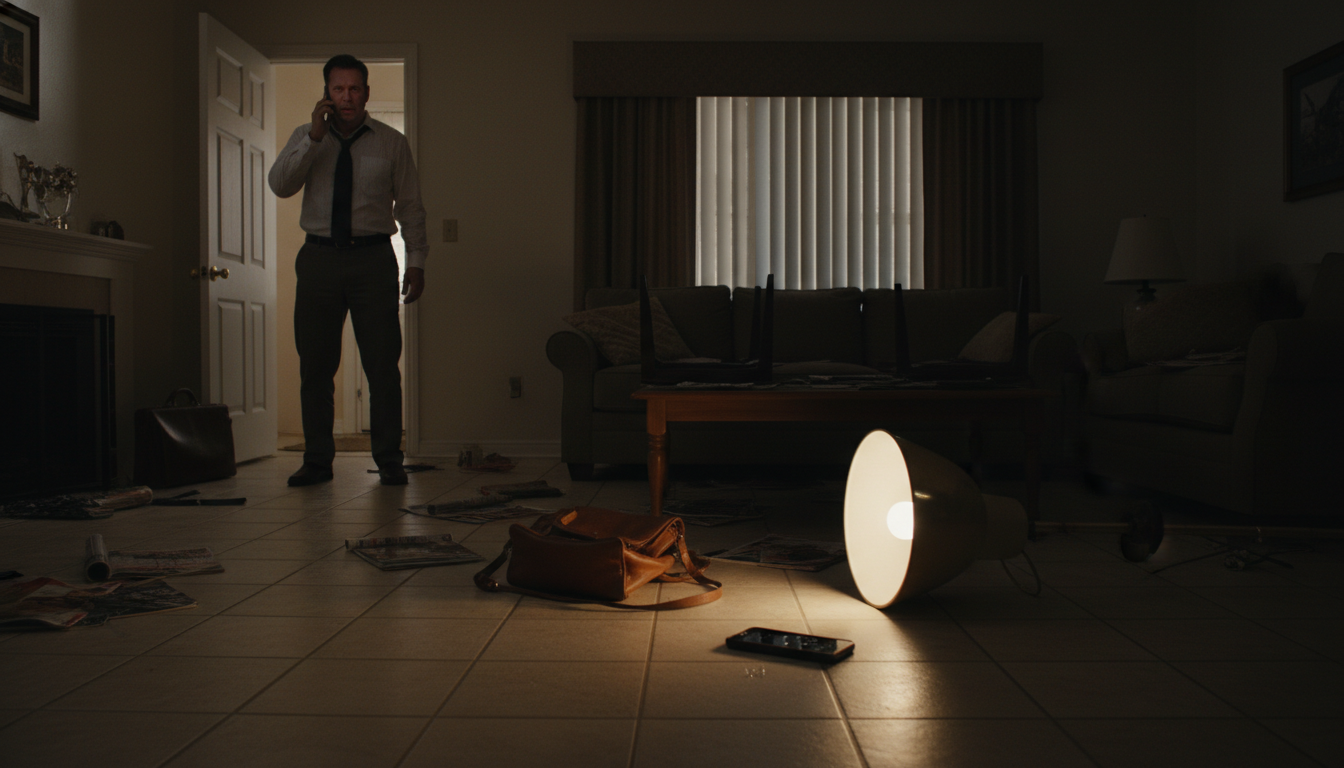
The entryway was chaos. Her purse — the brown leather one she never left without — was on the floor, contents scattered. Lipstick. Keys. Her phone, screen cracked, face-down on the tile.
“Jane!”
He moved fast now, through the living room. The coffee table was overturned, magazines fanned across the rug. A lamp lay on its side, still on, casting a long pale oval on the ceiling. A chair had been pushed hard against the wall — hard enough to leave a scuff.
“JANE, WHERE ARE YOU? JANE!”
The kitchen was worse. A cabinet door hung open. A glass had shattered near the sink. Her reading glasses — the ones she always left on the counter — were broken in half on the floor.
Michael stood in the center of the kitchen and pressed both hands flat against the counter. He needed to breathe. He needed to think.
His hands were shaking.
He went through every room. The bedroom: drawers pulled out, her jewelry box open and empty. The bathroom: nothing obviously wrong except a towel on the floor and the faucet dripping. The guest room: untouched.
He called her name eighteen more times.
He counted later, in the hospital waiting room. Eighteen.
Back in the kitchen, he picked up her cracked phone. Four missed calls — all from a number he didn’t recognize. No texts. The phone locked him out after one wrong passcode attempt.
He set it down carefully, like it might break further.
Then he picked up his own phone and dialed.
“911, what’s your emergency?”
“Please come quickly.” His voice cracked on the second word. He stopped. Started again. “My wife is gone. I came home from work and — my Jane is gone. The whole house is a mess.”
“Sir, I need you to stay calm. Can you tell me your address?”
“214 Maple Creek Drive. Please — she’s not here. Her purse is on the floor, her phone is broken, there’s — something happened. Something happened here.”
“Are you safe right now? Is anyone else in the home?”
Michael hadn’t thought about that.
He turned slowly, looking down the hallway toward the bedrooms. The lights were off. He hadn’t checked the closets.
“I don’t know,” he said.
“Sir, I’m dispatching units to your address right now. I need you to go outside and wait by the street. Do not go further into the house.”
“She’s my wife.”
“Sir—”
“She’s been here. Her glasses are broken. She wouldn’t — Jane doesn’t go anywhere without her phone, do you understand? She wouldn’t just—”
“Sir. Please go outside.”
He went outside.
He sat on the front step with his elbows on his knees and his phone between his hands and he stared at the open front door. The lamp inside was still casting that pale oval on the ceiling.
The first patrol car arrived in four minutes.
Officer Dana Reyes introduced herself and her partner, Officer Taft. She had a calm face and a clipboard and she asked Michael everything twice — when he’d left for work, when Jane’s schedule usually looked like, whether they’d argued, whether Jane had friends or family she might visit without telling him.
“No,” Michael said, to every version of that last question. “We tell each other everything.”
Officer Reyes wrote something down.
“Did she seem different this week? Anxious? Distracted?”
Michael started to say no again.
Then he stopped.
“She was quiet at breakfast,” he said slowly. “Tuesday. I asked if she was okay and she said she was tired. I thought she was tired.”
“Was that unusual for her?”
“A little. She’s usually…” He looked at his hands. “She talks in the morning. She tells me things.”
Officer Reyes nodded. “We’re going to need a recent photo, any medical information you have, and a list of people she might contact. Do you think you can do that?”
“Yes.”
He could do that. That was something he could do.
Inside, forensics arrived and moved through the house with gloves and flashlights. Michael sat at the kitchen table — the one surface that hadn’t been disturbed — and answered questions and pulled up photos on his phone and tried not to look at her broken glasses still on the floor.
At 9:15 PM, Officer Reyes sat across from him.
“We found something,” she said. “In the garage.”
Michael stood up.
“Her car is gone. The garage door was shut, but her car is gone. The security footage from your neighbor at 43 — they have a camera that covers part of your driveway. We got a partial plate.”
“She drove away?”
“It appears so, yes.”
Michael sat back down. “That doesn’t make sense. Her phone is here. Her purse is here.”
“I know.”
“You don’t just — you don’t leave your phone and drive away. Not Jane.”
“Mr. Caldwell.” Reyes leaned forward slightly. “Does the name Holloway mean anything to you? Daniel Holloway?”
The room got very quiet.
Michael’s face did something Officer Reyes would later describe in her report as “a recognition the subject appeared to suppress immediately.”
“That’s her brother,” Michael said. “Her half-brother. They don’t talk.”
“Can you tell me why?”
A long pause.
“Money,” Michael said. “Their mother’s estate. Jane got most of it. He didn’t take it well.”
Officer Reyes wrote something down.
“He made threats,” Michael said quietly. “Two years ago. We filed a report. It didn’t go anywhere.”
Reyes looked up. “Do you have documentation of that?”
“Jane kept everything.”
They found it in the locked drawer of her desk — the one Michael had forgotten the combination to. Forensics opened it in ninety seconds. Inside: a folder, neatly labeled, dated. Three years of emails. Two police reports. A restraining order that had lapsed eight months ago and that Jane had told Michael she’d renewed.
She hadn’t renewed it.
“She didn’t want me to worry,” Michael said, when Reyes showed him the lapsed paperwork. His voice was completely flat.
By 11 PM, they had Daniel Holloway’s current address from a parole record — he’d done eighteen months for assault, released fourteen months ago. Two detectives drove there.
At 11:43 PM, Michael’s phone rang.
Unknown number.
He answered it before the first ring finished.
“Michael.” Jane’s voice. Breathless, but present. Real. “Michael, I’m okay. I’m at County General. I’m okay.”
He was already standing. “What happened? Jane, what—”
“He was in the house. He’d been in the house for — I don’t know how long. I came home and he was just there. In the kitchen.” A pause. A sound like she was steadying herself. “I ran. I got to the car. I drove.”
“You didn’t have your phone—”
“It fell. I didn’t stop. I just drove.” Another pause. “I should have told you about the restraining order. I’m sorry. I thought I was protecting you.”
Michael was already moving toward Officer Reyes, gesturing, pointing at the phone.
“Tell me you’re in a safe place,” he said.
“I’m in the ER. Security is with me. They called 911 from the hospital.”
“I’m coming.”
“Michael—”
“I’m coming right now.”
Daniel Holloway was arrested at his apartment at 12:08 AM. He had Jane’s laptop in a bag by the door. The DA filed charges the following morning: breaking and entering, burglary, violation of a prior restraining order, and criminal threatening.
The judge at the arraignment denied bail.
Michael sat next to Jane in the ER until 3 AM, when they finally let her go home. She had a bruised wrist from where she’d grabbed the door frame pulling herself out of the house. That was the only mark.
In the car, driving back to Maple Creek Drive — where a neighbor had volunteered to sit with the house until they returned — Jane said, “I didn’t renew it because I thought he’d moved on.”
“I know.”
“I was wrong.”
“I know.” Michael reached across and took her hand. Her wrist was wrapped. He held her hand carefully. “Next time you’re protecting me from something — don’t.”
She laughed, short and sharp. “Okay.”
“I mean it.”
“I know you mean it.”
The house had been cleaned and straightened by the time they got there. The lamp was upright. The coffee table was back in place. Someone had swept up the broken glass.
Her reading glasses were still in two pieces on the counter.
Michael picked them up, looked at them for a moment, and set them in the trash.
“I’ll get you new ones tomorrow,” he said.
Jane leaned against the counter and watched him.
“Okay,” she said.
It wasn’t the end of it — there would be court dates, a trial, testimony. But Daniel Holloway spent that night, and every night that followed, in a cell. And Jane spent that night in her own house, in her own bed, with her husband’s hand on hers.
Sometimes justice is a verdict. Sometimes it’s just coming home.

Related Posts