Adam woke up alone the night before his wedding… and found his fiancée kissing his best friend in the dark.
The resort was the kind of place that made people believe in fresh starts. Pine trees, a private lake, a wraparound porch with rocking chairs nobody actually used. Four friends, two couples, one week — and at the end of it, a wedding.
Adam had booked it himself. Spent three months planning every detail.
Ellen had cried when she saw it. “It’s perfect,” she said. “You’re perfect.”
He believed her.
The four of them had been inseparable since college. Adam and Jack had been roommates freshman year — two guys from small Midwestern towns who’d found each other in the chaos of orientation week. Kate had come along junior year, quiet and steady, the kind of woman who remembered everyone’s coffee order and never made a big deal out of it. Ellen had arrived last, a friend of a friend at a birthday party, laughing too loud at a joke Adam made that wasn’t even that funny.
He’d loved her immediately for that.
Now they were thirty-one, and the four of them were at Cedar Ridge Resort, and in four days, Adam and Ellen were going to get married in front of twelve people on a dock overlooking the lake.
Jack was going to be the best man.
The first two days were easy. They hiked the ridge trail, grilled on the back deck, played cards until midnight with too much wine. Adam watched Ellen laugh at Jack’s stories and felt nothing but gratitude — gratitude that his life had turned out like this, full and warm and certain.
Kate was quieter than usual. He noticed, but didn’t push.
On the third night, Adam fell asleep early. The altitude, he told himself. Or the hiking. He was out by ten, Ellen curled against him, her breathing slow.
He woke at 2:14 a.m.
The bed was empty.
He lay still for a moment, listening. The bathroom was dark. The room was dark. The whole cabin was silent in the way that felt wrong — not peaceful, but held.
He got up.
The hallway was dim, the nightlights casting yellow pools along the hardwood. He checked the kitchen first. Empty. The back porch. Empty. He was about to go back to bed, tell himself she’d stepped out for air, when he heard it.
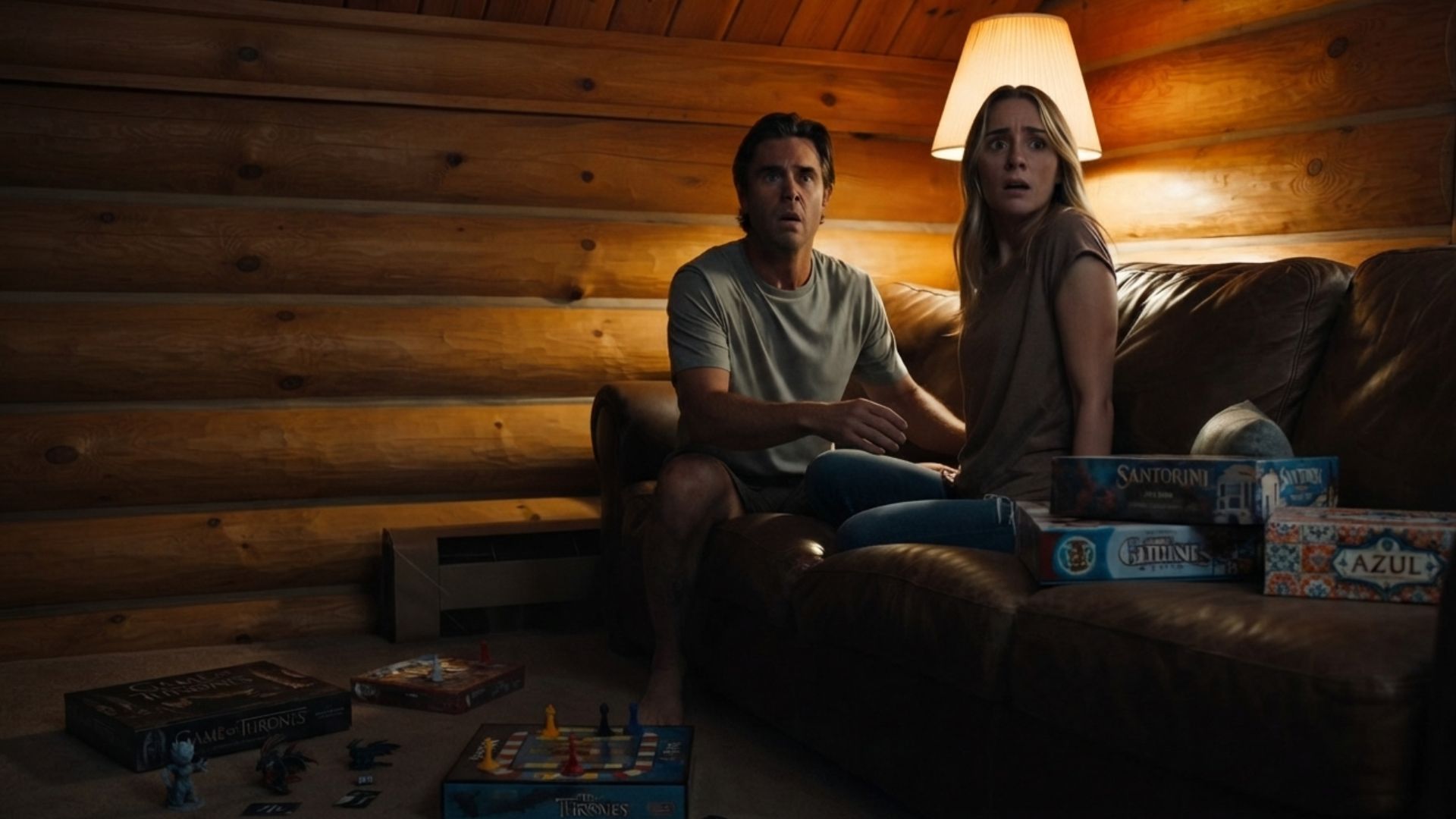
Voices. Low. From the playroom at the end of the hall — the one with the pool table and the board games and the old leather couch that smelled like cedar.
He walked toward it without thinking.
The door was cracked. Warm lamplight spilled through the gap.
He stopped.
“—you can’t do this,” Ellen’s voice. Tight. Like she was trying to keep something inside herself. “Jack, we talked about this.”
“I know.” Jack’s voice. “I know we did. I’m sorry. I just — I can’t watch you walk down that aisle, Ellen. I can’t stand up there and hand you off and pretend—”
“Stop.”
“I’m not going to stop. Not anymore.”
Adam stood in the hallway. He did not move. He did not breathe.
“He loves you,” Jack said. “I know he does. But you love me. You’ve loved me since before you even knew you were doing it. And I’ve been trying to be good about it, I’ve been trying to just be your friend, but I’m done pretending it’s not real—”
“Jack—”
“Don’t marry him.” His voice cracked on the last word. “Please. I’ll end things with Kate. We’ll figure it out. We’ll tell them together. It’s going to be awful and it’s going to hurt everyone but it’s better than lying for the rest of our lives. Please, Ellen.”
Silence.
Then: the sound of them moving. The creak of the couch. A soft sound Adam had heard before, in different contexts, in different rooms — a sound that now rearranged everything he thought he knew.
They were kissing.
He pushed the door open.
The three of them froze.
Ellen pulled back first. Her face went white. “Adam—”
He didn’t say anything. He stood in the doorway and looked at them — his fiancée, his best friend, on the couch in the lamplight — and felt the world quietly come apart at the seams.
Jack stood up. “Adam. Listen—”
“Don’t.” Adam’s voice came out calm, which surprised him. “Don’t do the thing where you explain it.”
“It’s not — this isn’t what—”
“It’s exactly what it looks like.” He looked at Ellen. “Isn’t it?”
She didn’t answer. That was its own kind of answer.
He went back to his room. He sat on the edge of the bed for a long time.
At some point Kate knocked on the door. She came in and sat beside him without saying anything, and he understood from the look on her face that she already knew — or had suspected, or had been carrying something similar in her chest for a long time without letting herself look at it.
“How long?” he asked her.
She shook her head. “I don’t know exactly.”
“But you knew something.”
“I knew something.” She looked at her hands. “I told myself I was wrong. That it was nothing. That people look at each other sometimes and it doesn’t mean anything.”
“It meant something.”
“Yeah.” Her voice was barely audible. “I think it did.”
By morning, Adam had packed his bag.
He’d already called the venue — a small deposit lost, the rest refundable. He’d texted the twelve guests. He’d canceled the florist and the photographer and the woman who was going to make the cake with the white fondant and the small sugar flowers Ellen had chosen from a catalog six months ago, pointing at them with so much joy it had almost made him cry.
He thought about that now. He tried to figure out whether she’d been thinking about Jack in that moment, or whether there were also moments she’d meant it — meant him, meant them — and found he couldn’t separate it. Maybe that was the worst part.
Ellen came to his door at seven.
“Can I come in?”
“No.”
A pause. “Adam. Please. I want to explain—”
“You don’t need to explain anything, Ellen. I heard everything.”
“It’s complicated.”
“I know it’s complicated.” He picked up his bag. “But complicated doesn’t mean it’s not what it is.”
She was crying now. “I never wanted to hurt you.”
He looked at her for a long moment. She was still the same woman he’d loved. He didn’t know how to hold that alongside everything else.
“I know,” he said. “I don’t think you’re a bad person. I think you were in love with the wrong guy and didn’t tell me. And I think that’s going to take me a long time to get over, but that’s not something you can help me with.”
He walked past her. She didn’t follow.
Kate was on the back porch with two cups of coffee.
She held one out when she heard the screen door. Adam took it and sat in the chair beside her, and they looked out at the lake together — still and silver in the early morning light, the pine trees reflected perfectly in its surface.
“You okay?” she asked.
“No.” He wrapped both hands around the mug. “Are you?”
“No.” A beat. “But I’m going to be.”
“Yeah.” He exhaled. “Me too.”
Jack came out twenty minutes later. He stood at the door for a second, then walked to the railing and kept his back to them.
“I’m sorry,” he said.
Adam didn’t answer right away. He thought about ten years of friendship — the 2 a.m. drives, the time Jack had shown up at the hospital when Adam’s dad had his surgery and just sat there, the standing joke between them that had started freshman year and never stopped being funny.
He thought about last night.
“I know you are,” he said finally. “But I need you to go. Take Ellen and go home today. I’ll let you know when I’m ready to talk. Don’t push it.”
Jack turned around. His face looked like it had aged overnight. “Okay.”
He went inside.
Kate and Adam stayed on the porch until the sound of the car pulling out of the gravel drive faded through the trees.
“What are you going to do?” Kate asked.
“Spend a few days here, I think. I already paid for it.” He almost laughed. Didn’t quite. “Then go home. Figure it out. File the paperwork.”
Kate turned to look at him. “Which paperwork?”
He met her eyes. “Mine. And I’m guessing yours.”
She looked back at the lake. Her jaw tightened once, then released. “Yeah.”
“I’m sorry.”
“Don’t be sorry for them.” She shook her head. “That’s not yours to carry.”
Three weeks later, Adam got a call from his lawyer.
Ellen had signed everything. Clean, no contest — the apartment was his, the savings split down the middle, no drama. His lawyer sounded almost disappointed at how straightforward it was.
“That’s it?” Adam asked.
“That’s it.” A pause. “You doing all right?”
“Getting there.”
He hung up and sat for a minute in his kitchen, coffee going cold, sunlight coming through the window at an angle that hit the countertop and made it look warmer than it was.
His phone buzzed. Kate.
Just finished mine too. Want to get coffee sometime? As civilians.
He stared at the message. Something in him — bruised and careful — considered it.
He typed back: Yeah. I’d like that.
Six months later, Adam ran into Jack at the grocery store.
It was not cinematic. It happened in the cereal aisle, by the granola, on a Tuesday afternoon. Jack looked thinner. He had the kind of expression that comes from sleeping badly for a long time.
They stood there.
“Hey,” Jack said.
“Hey.”
A long beat. The kind that might have been angry a few months ago but had settled into something quieter.
“How are you?” Jack asked.
“Good, actually.” And he meant it. “You?”
Jack looked down at his cart. “Trying.”
“Yeah.” Adam nodded. “Good luck with that.”
He moved past him. He didn’t look back.
That night, he met Kate for dinner — their fourth since she’d moved into a place across town. She was already at the table when he arrived, reading something on her phone, relaxed in the way that people are when they’re not performing anything for anyone.
She looked up when she saw him.
“You’re late.”
“Ran into Jack at the store.”
Her expression shifted slightly. “And?”
“And nothing. It was fine.” He sat down. “Weird. But fine.”
She held his gaze for a second, reading him. Then she picked up the menu.
“Okay,” she said simply.
He opened his own menu. Under the table, his shoulders dropped — the last bit of tension that had been living between them like a question he hadn’t known how to ask.
“What are you getting?” he said.
“The pasta. You?”
“Same.”
She smiled. Just barely. Just enough.
The waiter came. They ordered. Outside, the city moved through its ordinary evening, indifferent and alive.
Adam looked across the table and thought: this.
Not with drama. Not with the weight of everything that had led to it. Just with the quiet, certain recognition of someone who had learned, the hard way, what was real.
This is what it’s supposed to feel like.

Related Posts