A sick girl finally forced herself to go to class wearing a wig — then a bully ripped it off in front of everyone. But the school official who walked in at that exact moment was the last person anyone expected.
Sylvie sat on the edge of her bed at 6:47 in the morning, staring at the wig on her dresser like it was a piece of armor she wasn’t sure she deserved to wear.
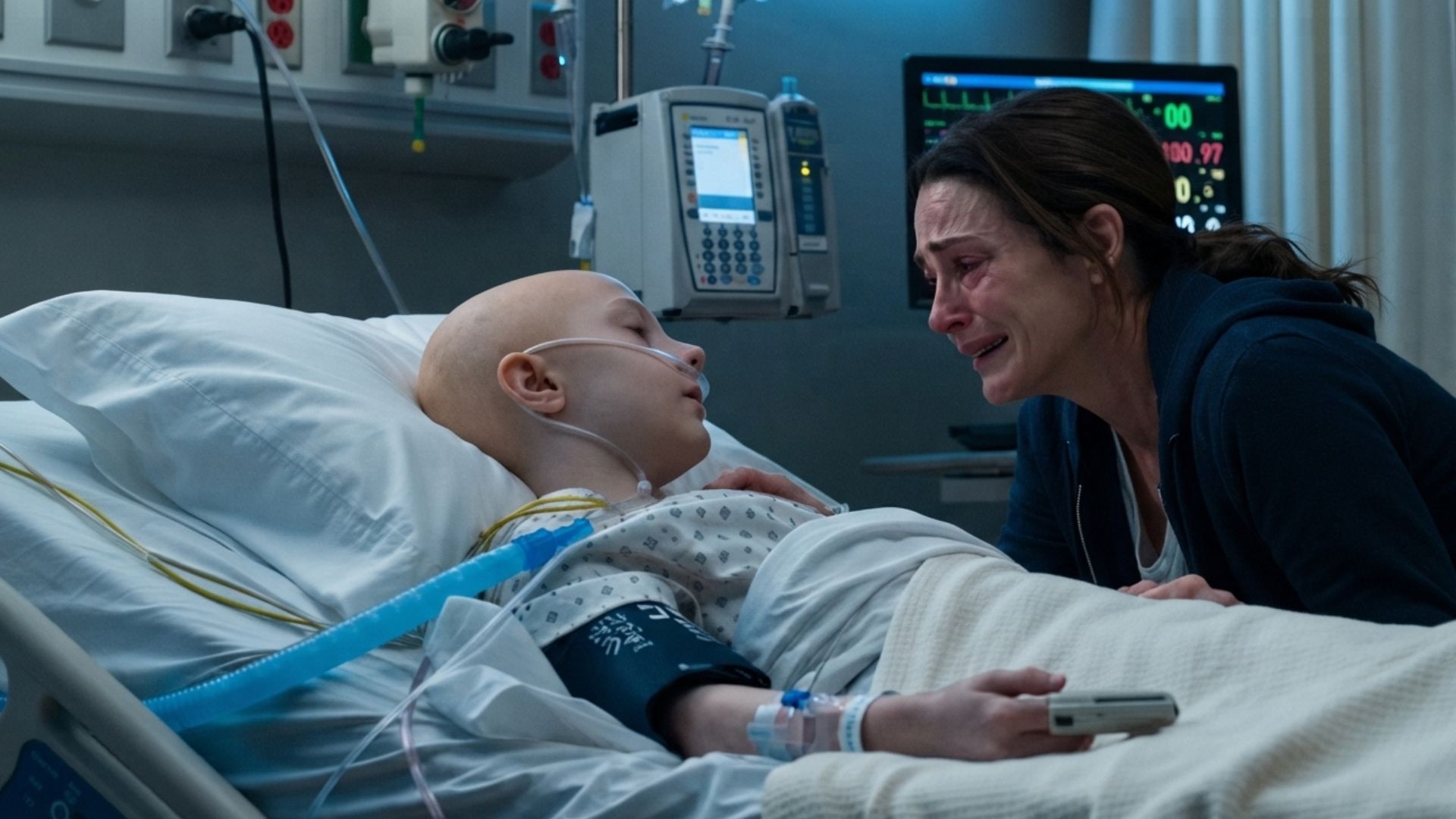
Three months. That’s how long she’d been gone. Three months of IV drips, of nurses who pretended not to notice when she cried, of watching her hair collect in the shower drain until there was nothing left.
She pressed her palm to her bare scalp. Cold. Smooth. Wrong.
“You don’t have to go today,” her mom called from the hallway.
“Yes I do,” Sylvie said. “The semester’s already half gone.”
She picked up the wig and pulled it on. Dark brown waves, almost exactly like her real hair used to look. She studied her reflection. If you didn’t know, you wouldn’t know.
She told herself that six times on the bus ride over.
Westfield High hadn’t changed. Same yellow lockers. Same linoleum floors that squeaked in the rain. Same clusters of kids who looked right through you if you weren’t in their orbit.
Sylvie walked with her chin level, her backpack strap gripped in both hands. She found her homeroom, sat in the third row, and opened her binder.
The girl next to her didn’t acknowledge her. That was fine. Fine was enough.
Mr. Callahan started roll call. When he said “Sylvie Mercer,” three people turned around. She raised her hand. She kept her face neutral.
One of them — a boy named Derek, she’d known him since sixth grade — squinted at her and then leaned over to the kid next to him and said something she couldn’t hear.
Both of them laughed.
She looked back at her notebook.
The real trouble started in second period. AP English. Mrs. Fontaine hadn’t arrived yet, and the room was loose and loud, desks scraped into clusters, someone’s phone playing a tinny beat from the back corner.
Sylvie found a seat near the window. She took out her copy of The Awakening and opened it to the dog-eared page.
“Hey.”
She looked up. Derek again. He’d followed her. Or maybe it was coincidence. She gave him nothing.
“Hey, I’m talking to you.” He sat backward on the desk in front of her, arms crossed over the chair back. “Where’ve you been? You look different.”
“I was sick,” she said. “Excuse me, I’m trying to read.”
“Sick.” He nodded slowly, like he was tasting the word. “You look like you lost weight. And like… I don’t know. Your face looks different. Boring, kind of.”
Someone behind her snickered.
“Boring face,” Derek said again, louder now, because it had gotten a laugh. “Like a blank doll.”
Sylvie kept her eyes on the page. The words blurred.
“Seriously what happened to you? You used to be—” He made a vague gesture. “Now you’re just… I don’t know.”
“Leave her alone, Derek,” said a girl named Priya from across the room. Her voice had no real force behind it. A formality.
Derek ignored her. He was looking at Sylvie with a smirk that had found its shape and wasn’t giving it up.
“Is that a wig?”
Sylvie’s hands went still on the pages.
“No,” she said. Too fast.
“It is.” He leaned forward. “It totally is. Oh my God, it’s a wig.”
“Derek—” Priya tried again.
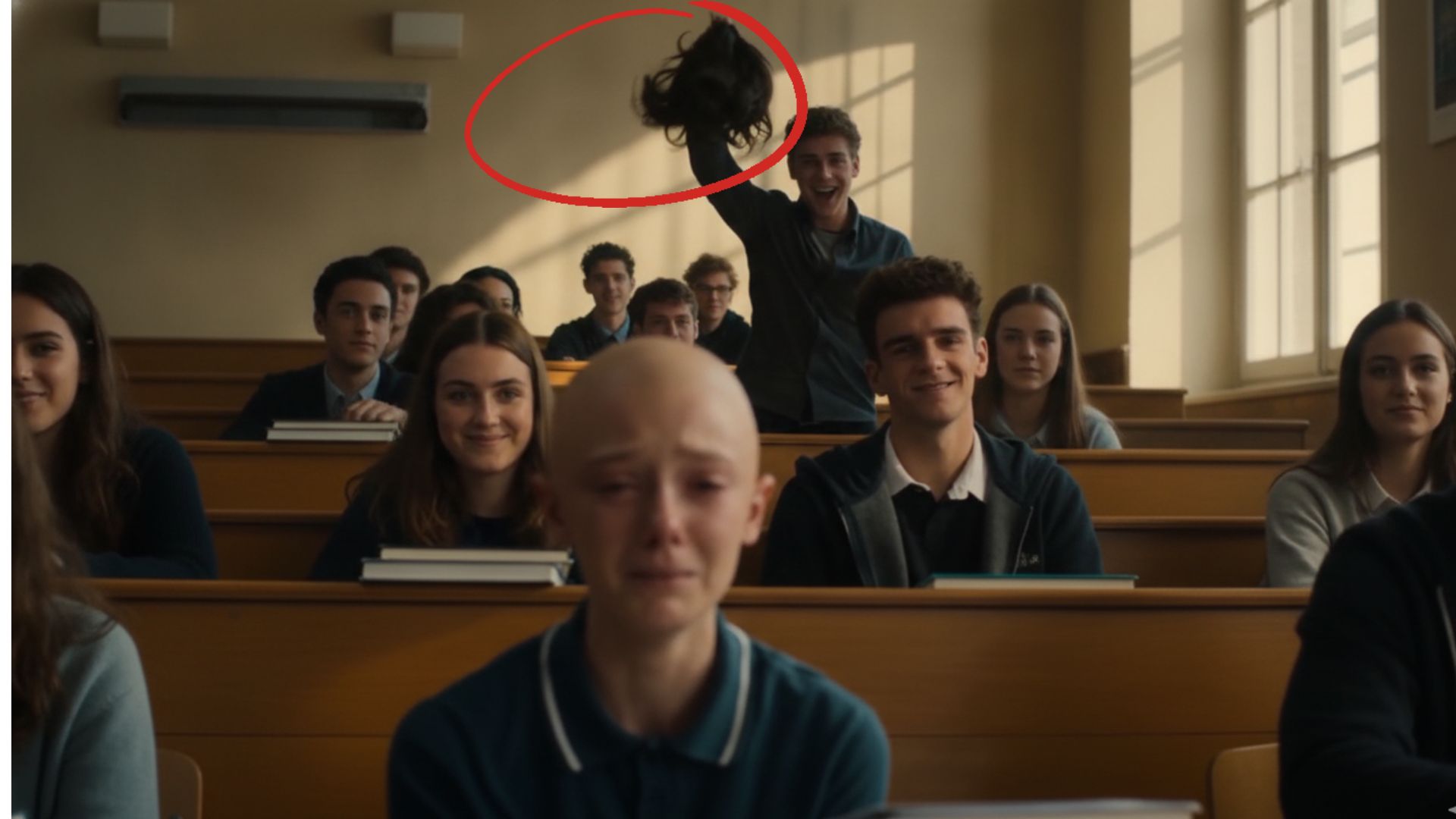
“Is your hair fake? Let me see.” He reached out. She pulled back. But he was faster, or she was slower than she thought — his fingers caught the edge of the wig and it came off in one sharp pull, and the room went completely silent.
Cold air on her scalp.
Twenty-two pairs of eyes.
Sylvie sat very still. She didn’t reach for the wig. She didn’t make a sound. She just sat there with her bare head and her open book and let the silence press down on her like water.
Then someone laughed. Just one person. But that was all it took.
“Oh wow—”
“She’s got nothing up there—”
“What happened to her—”
Derek held the wig up like a trophy, turning it in his hand. “Anyone want to try it on?”
More laughter. Sylvie kept her eyes on the page. Edna had not intended to be overcome. The words swam. She blinked.
She would not cry. She would not give him that.
The door opened.
Mrs. Fontaine walked in — but she wasn’t alone. Behind her was a man in a charcoal suit, broad-shouldered, carrying a leather folder, looking around the room with the calm authority of someone who didn’t need to announce himself.
“Settle down,” Mrs. Fontaine said, reading the energy immediately. “What’s going on?”
No one answered.
The man’s eyes moved across the room. They landed on the wig in Derek’s hand. Then they moved to Sylvie.
He went very still.
It lasted only a second. Then he crossed the room in six strides and crouched down next to her desk, and his voice — quiet, controlled, devastating — said, “Who did this?”
Sylvie looked at him. Her lip was trembling. She pressed it still.
“Sweetheart.” He said it so gently the whole room seemed to contract. “Who hurt you?”
Derek’s smirk had collapsed into something uncertain. He was still holding the wig.
The man stood up and turned around and looked at Derek with an expression that wasn’t rage — it was worse than rage. It was disappointment weaponized. Certainty.
“Is that hers?” He nodded at the wig.
Derek didn’t answer.
“Put it down.”
Derek put it on the desk.
The man turned back to the room. “I’m going to ask Mrs. Fontaine to get the principal. Whoever was involved in this is going to be removed from this class today.” He looked at Derek specifically. “And depending on what I find out in the next ten minutes, possibly from this school.”
Mrs. Fontaine was already at the door, phone in hand.
Sylvie reached forward and picked up the wig from the desk. She held it in her lap.
“Dad,” she said quietly. “You don’t have to.”
The room broke open.
Dad.
The word went through the class like a current. Every face changed. Priya’s hand went to her mouth. Derek went pale. The kid in the back corner who’d been laughing stopped laughing so completely it was like someone had hit a switch.
Sylvie’s father — Richard Mercer, the district’s new Deputy Superintendent, two weeks into his role, here today for a routine curriculum review — looked down at his daughter.
“I absolutely do,” he said.
“It’ll make things worse,” she said. “For me. After.”
“That’s not how this works.”
“Dad.” Her voice cracked. Just slightly. “Please. I just want to get back to class. That’s all I wanted today. Just to get back to class.”
He looked at her for a long moment. His jaw worked. Then he straightened up and pulled a chair from a nearby desk and sat down beside her, not behind her, not in front of her — beside her, like he was staying.
“Okay,” he said. “Then we’ll start there.”
He didn’t make a scene. That was almost worse, for the people who deserved a scene.
He stayed through the whole period. Sat next to Sylvie while Mrs. Fontaine, rattled and overcompensating, launched into the lesson. Nobody laughed. Nobody said a word out of place. Derek sat rigid in his seat with his hands flat on his desk like he was trying to disappear into the furniture.
After class, Richard Mercer stopped Derek in the hallway.
Sylvie didn’t hear what he said. She was already walking ahead, wig back in place, binder against her chest. But she heard Derek’s voice — and it was small. The voice of someone who had just understood, very suddenly, that the person he’d humiliated in front of twenty-two people had a father who knew every administrator in this district by their first name.
By lunch, the story had moved through the school the way stories do — fast, changed slightly at every telling, but with the same core: Derek pulled off a sick girl’s wig in English, and her dad turned out to be the new deputy super.
Priya found Sylvie at a corner table in the cafeteria.
“Can I sit?”
Sylvie looked up. “Sure.”
Priya sat down. She was quiet for a moment, picking at the edge of her sandwich wrapper.
“I should have said something more,” she said. “When it was happening. I just said ‘leave her alone’ and that was—” She shook her head. “That was nothing.”
“It was something,” Sylvie said. “It was more than most people.”
“It wasn’t enough.”
Sylvie considered that. “No,” she said. “It wasn’t. But I appreciate that you know the difference.”
Priya nodded. They ate in silence for a while, and it was the comfortable kind.
Three days later, Derek Hollis received a formal written warning, a mandatory meeting with the school counselor, and a two-week removal from AP English pending a behavior review. His parents were called in. The phrase “targeted harassment of a student with a medical condition” appeared in the documentation.
He sent Sylvie a text that night.
im sorry. i know that doesnt fix it.
She read it. She didn’t respond.
That was its own kind of answer.
The following Monday, Sylvie walked into AP English without her wig.
She’d thought about it all weekend. Turned it over. Put the wig on, took it off, put it on again. Stood in front of the mirror and tried to figure out which version of herself she was least afraid to be.
In the end, she decided she was tired of being afraid of her own reflection.
She sat in the third row. Opened The Awakening. The room was quiet.
Mrs. Fontaine didn’t say anything. Priya gave her a small nod. A boy named Marcus, who she’d never spoken to before, slid a pack of gum across the aisle and said, “You want a piece?” like it was nothing. Like she was just a person.
She took a piece. “Thanks.”
He shrugged. “Yeah.”
When Mrs. Fontaine started the lesson, Sylvie opened to her page, found the sentence she’d lost three weeks ago, and started reading from exactly where she’d stopped.
She began to do as she liked and to feel as she liked.
Her father called that evening.
“How was school?”
“Fine,” she said. Then, after a pause: “Actually fine. Not just saying that.”
“Good.” She could hear him exhale. “You know you could have told me. About how bad it was getting.”
“I know.”
“Why didn’t you?”
She thought about it honestly. “Because I wanted to handle it. I wanted it to be mine to handle.”
“And?”
“And I couldn’t. Not alone.” She pulled her knees to her chest, phone pressed to her ear. “But you didn’t handle it for me, either. You just… stayed.”
He was quiet for a moment.
“That’s all I know how to do,” he said finally. “Show up and stay.”
“It was enough,” she said. “It was actually exactly enough.”
She finished the semester. 94 in AP English. The highest grade she’d ever gotten in that class.
She kept the wig in her dresser drawer. She didn’t throw it out — she’d paid three hundred dollars for it and it was a good wig. But she didn’t wear it again.
Her hair started coming back in February. Soft at first, like something tentative, then with more intention. By spring it was half an inch long and she’d started calling it her “baby hair” and Priya said it looked like a cool choice, not a medical fact.
“It kind of does,” Sylvie agreed.
“You could just say you did it on purpose.”
“I did do it on purpose,” Sylvie said. “Eventually.”
Derek transferred to a different AP section. She heard he was quieter now. She didn’t spend much time thinking about it.
The disease was still there — in remission, but there, something she’d carry. But it was hers, and she’d learned that carrying something wasn’t the same as being crushed by it.
She walked into every room now the same way she’d walked into AP English that Monday morning: without armor, without apology, and without giving anyone the satisfaction of making her small.
That was the whole of it. That was the part she kept.

Related Posts