A 10-year-old girl interrupted a world-class piano concert and told the pros she could beat them all… Then she sat down and proved it.
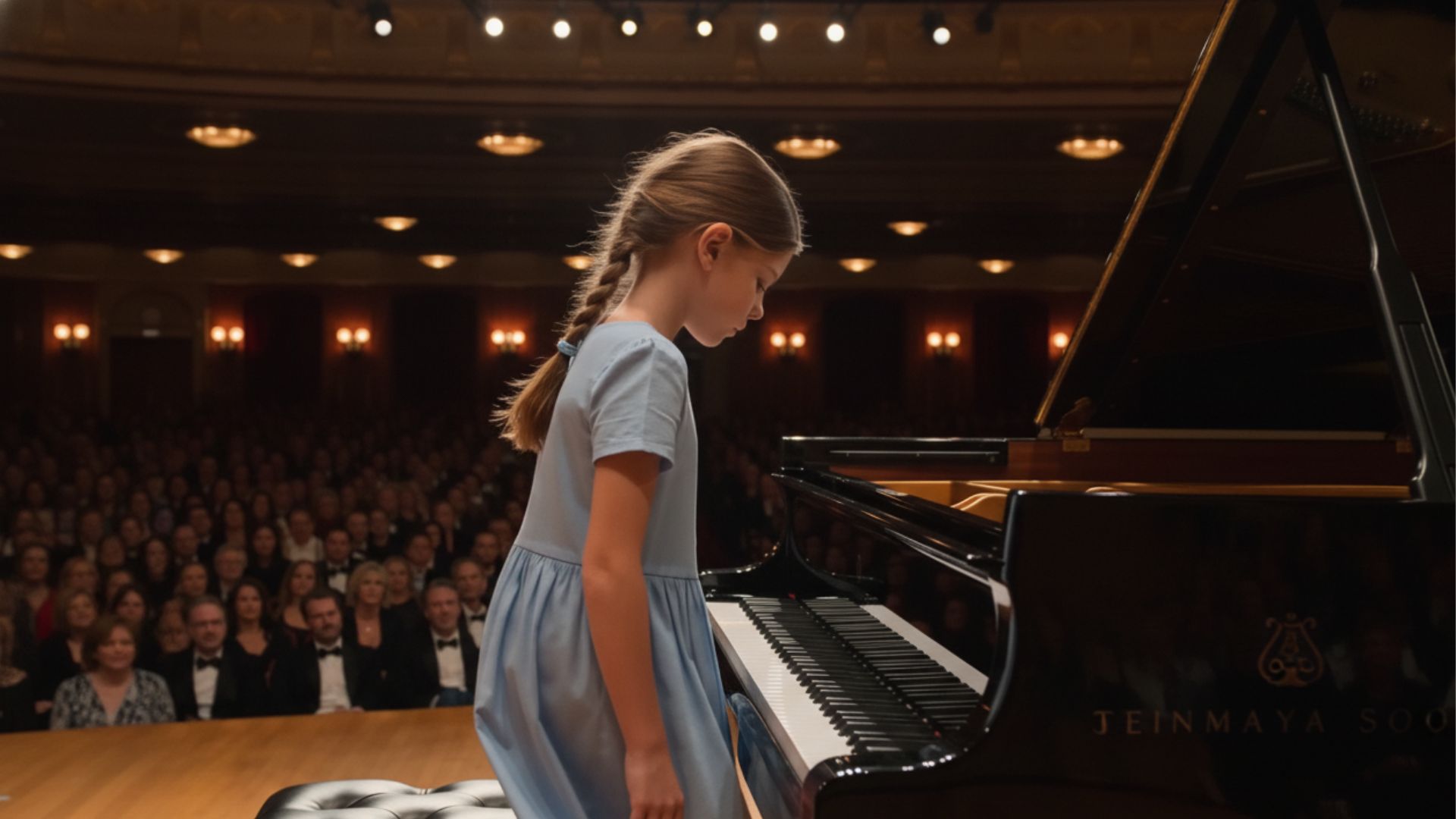
The Carnegie-style concert hall was packed. Every red velvet seat filled, every balcony leaning forward. The chandeliers were dimmed to a warm amber, and the stage held a single Steinway grand, polished to a mirror shine.
Marcus Hale, the host — silver-haired, tuxedoed, the kind of man whose voice alone commanded silence — stepped up to the microphone.
“Ladies and gentlemen, our next performer needs no introduction. Please welcome the incomparable—”
“Excuse me.”
The voice was small. But it cut through the hall like a pin dropped in a cathedral.
Marcus stopped. He turned. Every head in the audience turned.
A girl was walking up the center aisle. She looked ten years old, maybe younger — brown hair in a loose braid, a pale blue dress slightly too big for her, white sneakers that squeaked faintly on the polished floor. She held no sheet music. She carried nothing at all.
She stopped at the edge of the stage and looked up at Marcus.
“I can play better than anyone here.”
Not a whisper. Not a shout. Just a statement, the way you’d say the sky is blue.
The audience didn’t laugh. Not immediately. There was a beat — a collective inhale — and then a low ripple of uneasy chuckles from the back rows.
On the side of the stage, three of tonight’s pianists stood in the wings. Conrad Voss, sixty-two, three-time Grammy nominee, folded his arms. Elena Marsh, thirty-eight, former Juilliard faculty, raised one eyebrow. David Park, twenty-six, the evening’s rising star, pressed his lips together and looked at the floor like he wasn’t sure how to react.
Marcus recovered fast. He was a professional. He leaned into the microphone with a practiced smile.
“Well. That’s quite a claim, young lady.” He gestured warmly toward the piano. “Please — be our guest.”
He expected her to hesitate. To look back at a parent in the audience. To realize what she’d done and shrink.
She didn’t.
She walked up the side stairs to the stage, settled onto the bench, adjusted it two inches forward with both hands, and placed her fingers on the keys.
The hall went completely silent.
She didn’t look at the audience. She looked at nothing — eyes slightly down, head tilted, like she was listening to something no one else could hear.
And then she played.
The first chord landed and Marcus actually stepped back. Not from surprise — from the force of it. It wasn’t just technically correct. It was alive. Rachmaninoff’s Piano Concerto No. 2, the opening, the famous cascade of tolling chords — but played with a weight and intention that most professionals spent decades chasing.
Conrad Voss uncrossed his arms.
Elena Marsh’s eyebrow came down.
David Park’s mouth opened slightly.
The girl moved into the second phrase, and the hall seemed to lean in as one body. No one coughed. No one shifted. A woman in the third row had her hand pressed flat against her chest.
The piece built. The girl’s left hand drove the bass like a heartbeat, steady and enormous, while her right hand sang the melody with a control that felt almost inhuman in something so small. Her shoulders barely moved. Her face was calm. Her sneakers didn’t quite touch the floor.
At the two-minute mark, she reached the first climax — the soaring passage that professional pianists describe as the emotional center of the entire concerto — and she didn’t just reach it. She detonated it.
The sound filled every cubic inch of the hall.
Somewhere in the middle of the audience, a man started crying. He didn’t know why. He’d tell his wife about it afterward, embarrassed, and she’d tell him she felt the same thing.
When the girl finally lifted her hands from the keys, the silence lasted three full seconds.
Then the hall came apart.
The standing ovation started in the front row and moved like a wave — not the polite, gradual kind, but the kind where people are already on their feet before they’ve consciously decided to stand. Applause thundered off the walls. People were shouting. Someone in the balcony was whistling through their fingers.
The girl turned on the bench and looked at the audience with an expression that wasn’t pride, exactly. It was more like acknowledgment. Like she’d known this was coming and was simply receiving it.
Marcus stood at the edge of the stage, applauding with everyone else, his microphone forgotten at his side.
Conrad Voss walked out from the wings. He crossed the stage — not quickly, but deliberately — and stopped beside the piano bench. He looked down at the girl for a long moment.
“What’s your name?” he said.
“Lily,” she said.
“How old are you, Lily?”
“Ten.”
“How long have you been playing?”
She thought about it. “Since I was three.”
Conrad Voss was quiet. He was a man who had been celebrated for sixty years. He had played for heads of state. His recordings sold in forty countries. He looked at this girl in her oversized dress and her white sneakers and he did something almost no one in the audience had ever seen him do.
He bowed.
Not a head nod. A real bow — hand to his chest, shoulders forward, the kind of bow you offer to someone whose gifts exceed your own.
“It’s an honor,” he said.
The audience lost its mind all over again.
Elena Marsh came out next. She crouched down to Lily’s eye level.
“Where do you study?” she asked.
“My grandfather teaches me,” Lily said. “He played at this hall. A long time ago.”
Elena looked up at Marcus. Marcus was already scanning the audience. He found what he was looking for in the fourth row — an elderly man, small and white-haired, sitting very still in his seat while everyone around him stood and cheered. The man’s eyes were fixed on the stage. His hands were folded in his lap. His expression was one of absolute, private pride.
Marcus stepped to the microphone.
“Ladies and gentlemen — if you would, please direct your attention to the fourth row.” He paused. “I believe we have another guest of honor this evening.”
The spotlight swung. The old man blinked in the sudden light. For a moment he seemed startled, almost alarmed.
Then Lily stood up from the bench and waved at him from the stage, and he smiled — a slow, full smile that rearranged his whole face — and the hall cheered even louder than before.
David Park walked out from the wings, shaking his head slowly. He stopped next to Elena.
“I’ve been practicing eight hours a day for twenty years,” he said to no one in particular.
Elena Marsh patted his arm.
“So has she,” she said. “She just started earlier.”
Lily sat back down at the piano.
“Can I play one more?” she asked Marcus.
Marcus laughed — a real one, not a host laugh — and spread his hand toward the keys.
“The stage is yours,” he said.
She played Chopin this time. The Ballade No. 1. A piece that professional pianists call one of the most emotionally demanding in the entire repertoire. She played it start to finish, and when the final thunderous chords resolved into silence, the woman in the third row was crying openly now, not bothering to hide it.
When it ended, Lily stood, tucked the bench neatly back under the piano, and walked to the front of the stage.
She gave a small, precise bow.
Then she walked back down the stairs, down the center aisle, and sat back in her seat beside her grandfather.
He leaned down and said something quietly to her.
She leaned up and said something back.
No one heard what it was.
But the man in the row behind them — he would later tell the story at every dinner party for the rest of his life — swore that the old man’s eyes were wet, and that when the girl took his hand, he closed his fingers around hers like she had just given him something he’d been waiting a very long time for.
The evening’s scheduled program continued.
Conrad Voss, Elena Marsh, and David Park all performed brilliantly. The audience applauded warmly. The reviews the next morning would describe it as a memorable night.
But every review — every single one, even the most formal, even the most academic — led with the same sentence:
“Nothing that happened after the intermission could follow what a ten-year-old girl did before it.”

Related Posts