Her soldier disappeared at war with no word for over a year — so her father forced her down the aisle with another man. But as she picked up the pen to sign, the registry door flew open.
Sofia hadn’t cried in six months. She’d decided that was the only way to survive — no tears, no candles on the windowsill, no checking her phone at midnight for a notification that never came. Marcus had been gone fourteen months. The last message she had from him was a voice memo, crackling with static: “I’ll be back before the snow. I promise.”
It had snowed twice since then.
“You look beautiful,” her mother said, adjusting the veil in the mirror.
Sofia said nothing.
Her father knocked twice and opened the door without waiting. He was a big man with a square jaw and the kind of smile that never reached his eyes. “Car’s ready.”
“Dad.” She turned to face him. “I need you to hear me one more time.”
“Sofia—”
“I don’t love Daniel.”
Her father’s jaw tightened. “Daniel is a good man. His father is my oldest friend. This is what’s right for this family.”
“I don’t care what’s right for the family.” Her voice cracked. “I care about Marcus.”
“Marcus is gone.” He said it flatly. Not cruelly — just as a fact, the way you say the road is icy or the power’s out. “It’s been over a year. No word. No letter. The army hasn’t confirmed, but they haven’t denied either. You can’t wait forever.”
“Watch me,” she said quietly.
He stepped aside from the doorway. “The car is waiting.”
The registry office was a low beige building on the edge of town, unremarkable except for the flower boxes out front that someone kept alive through sheer stubbornness. Sofia sat in the back of the car watching them pass. Her bouquet was white roses. She hadn’t chosen them.
Daniel was already inside when she arrived. He was tall, fair-haired, pleasant-looking — the kind of man who was easy to be around and impossible to love. He smiled when she walked in.
“You look incredible,” he said.
“Thank you,” she said, because there was nothing else to say.
The guests were seated — thirty people, most of them her father’s friends and their wives. A few of Sofia’s cousins. Her best friend Anya stood near the window, arms crossed, eyes full of something she wasn’t allowed to say out loud.
The officiant was a middle-aged woman with reading glasses on a beaded chain. She smiled warmly and opened the folder. “Shall we begin?”
Sofia’s father nodded from the front row.
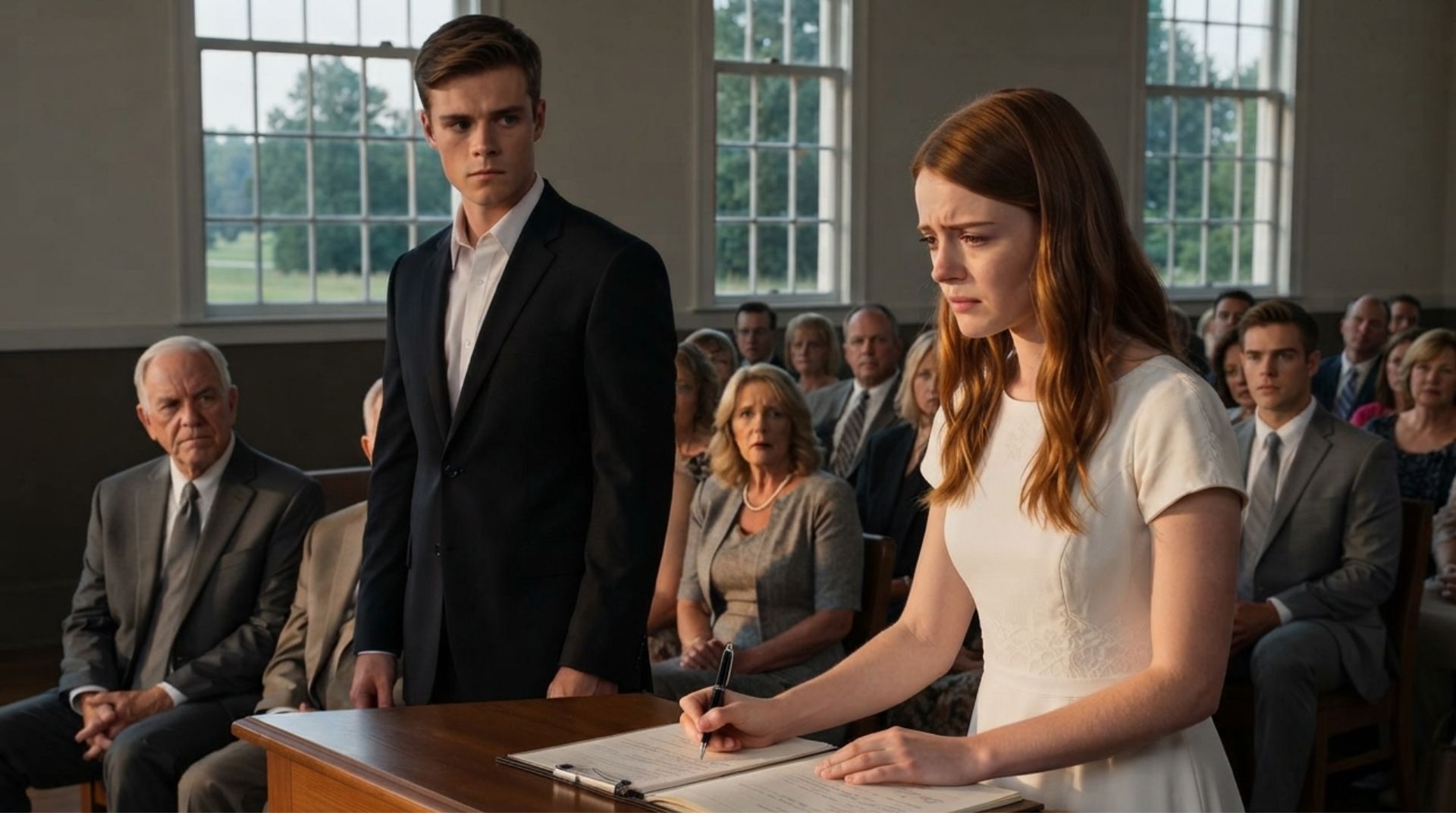
The words came. Sofia heard them the way you hear rain on a roof — present, steady, not quite landing. She answered where she was supposed to answer. She stood where she was supposed to stand. When the pen was placed in her hand, she looked down at it.
The paper was right there. Her name was already printed on it — Sofia Reeves — waiting for her signature to close the door on everything she’d been holding onto.
She pressed the tip to the line.
The door opened.
Not the side door. The front door — heavy oak, hinges loud. It swung wide and cold air rolled in from outside, and every head in the room turned.
A man stood in the doorway.
He was in military uniform, dusty at the collar, a duffel bag over one shoulder. His face was thinner than she remembered. There was a scar above his left eyebrow that hadn’t been there before. His eyes found her instantly — like he’d walked straight here without a single wrong turn.
“Sofia,” Marcus said. His voice was raw. “I’m here. Don’t make that mistake. Please.”
The pen dropped from her hand and hit the floor.
For one full second the room held its breath.
Then Sofia moved.
She crossed the space between them in five steps and walked straight into his arms. He caught her like she was the only solid thing in the room, pulling her in hard, his face going into her hair.
“You promised,” she said into his shoulder, half sob, half fury. “You promised before the snow.”
“I know.” His voice broke. “I know. I’m sorry. I’m so sorry.”
Behind her, the room erupted.
Her father was on his feet. “What is this?” His voice was low and dangerous. “Who let him in here?”
Daniel had taken a step back from the table. He looked at Sofia — really looked at her — and something shifted in his face. Not anger. Something quieter.
“Viktor.” Her mother put a hand on her husband’s arm. “Stop.”
“This is a ceremony—”
“It’s over,” Anya said from the window, loud enough to carry. She was smiling now, both hands pressed to her mouth. “It’s clearly over, Viktor.”
Sofia pulled back just enough to look at Marcus’s face. She reached up and touched the scar over his eyebrow. “What happened to you?”
“Long story.” He covered her hand with his. “I’ll tell you everything. All of it. I just needed to get here first.”
“You’re fourteen months late.”
“I know.”
“You could’ve called.”
“I was in a field hospital for six of those months. No signal. No outgoing.”
She searched his eyes. Found nothing but him — the same him she’d been waiting for through two winters. “Are you okay?”
“I’m standing in a registry office that isn’t mine,” he said, “watching the woman I love almost sign her life away. So — no. Not entirely.”
She laughed. It came out wet and messy and she didn’t care.
Daniel cleared his throat. He walked over slowly and stopped a few feet away. He looked at Marcus, then at Sofia.
“I didn’t know about him,” he said carefully. “My father said the situation was — resolved.”
“It wasn’t,” Sofia said.
“I can see that.” He paused. “I’m going to be honest with you. I wasn’t exactly thrilled about this arrangement either.” He glanced at her father. “No offense, Viktor.”
Her father said nothing.
Daniel picked up the pen from the floor and set it back on the table. “I think we’re done here.” He buttoned his jacket, nodded once at Sofia — genuine, without bitterness — and walked out.
Three of the guests followed immediately. Then two more. The officiant quietly closed her folder.
Viktor stood in the emptying room, chest tight, hands at his sides.
“You humiliated me,” he said to Sofia.
“You tried to erase someone I love because it was inconvenient for your friendship,” she said. “I think we’re even.”
“I was protecting this family—”
“By selling me.” Her voice was steady now. All the trembling was gone. “Don’t dress it up, Dad.”
Marcus stood behind her, one hand on her shoulder, saying nothing. He didn’t need to.
Her mother stepped forward and took Viktor’s arm. “Come on.” Her voice was quiet but firm. “Let’s go home.”
Viktor looked at Marcus for a long moment. Something moved behind his eyes — not apology, not yet, maybe not ever — but the wall came down just slightly. He looked at his daughter.
“He’d better be worth this,” he said.
“He is,” Sofia said.
They left.
Anya was the last one in the room besides the two of them and the officiant, who was gathering her things with the practiced discretion of someone who’d seen it all before.
“I need a minute,” Anya said, dabbing her eyes aggressively. “That was the most dramatic thing I have ever witnessed in this building, and I once watched a man faint during his own vows.”
“Go,” Sofia told her, laughing.
Anya grabbed her bag, pointed two fingers at Marcus, and said, “You have so much to answer for,” and walked out.
The room was empty now. Just the two of them and the flower arrangements and the afternoon light coming through the windows.
Marcus looked at the table — the unsigned paper, the dropped pen.
“That was close,” he said.
“Too close.” She turned to face him fully. “Fourteen months, Marcus.”
“I know.”
“I didn’t know if you were alive.”
“I know.” He pulled her in again, slower this time. “I’m going to spend a very long time making that up to you.”
“You are,” she agreed.
They stood there in the quiet registry office, holding each other in the wreckage of the ceremony that wasn’t theirs, in the city that had almost swallowed her whole. Outside, the flower boxes caught the afternoon sun.
Three weeks later, Sofia and Marcus sat across from an actual officiant of their choosing — a retired judge who owed Marcus’s commanding officer a favor — with Anya as witness and Marcus’s two army brothers crowding into the small city hall room with them.
Viktor was not invited.
Her mother came alone, slipping in five minutes before it started. She sat in the back row, hands folded in her lap, eyes bright.
The judge asked if they were ready.
“Yes,” Sofia said without hesitation.
This time, when the pen touched the paper, her hand was steady.
She signed her name. Marcus signed beside it. The judge stamped the document and said, “Congratulations,” and that was that.
Her mother cried in the hallway afterward. Sofia held her without saying anything, because some things don’t need words, and the ones that do could wait until her father finally found the courage to pick up the phone.
Six months later, he did.
It was a short call — two minutes, stilted, full of long pauses. But at the end of it, he said, “I’d like to meet him properly.”
“I know,” Sofia said. “Maybe soon.”
She looked across the kitchen at Marcus, who was making coffee and pretending not to listen. He raised an eyebrow.
She covered the phone for a second. “My dad wants to meet you.”
Marcus said, “Tell him I’ll bring dessert.”
She smiled. “He’ll bring dessert, Dad.”
A pause. Then, quietly: “Okay.”
She hung up and Marcus handed her a mug and neither of them said anything for a while. There was nothing left to say that hadn’t already been written — in a field hospital, in fourteen months of silence, in a registry office door swung open at the very last second. Some stories end before the last page. This one closed exactly where it should have.

Related Posts