She tracked her fiancé for weeks—and found him in a café with her best friend, arms around each other.
Maya had a feeling in her stomach she couldn’t shake. It started small — a glance at his phone that he pulled away too fast, a dinner he was twenty minutes late to with no explanation, a laugh he cut short when she walked into the room.
She didn’t say anything. Not yet.
She told herself she was paranoid. She told herself that six years meant something. She told herself that Daniel was not that kind of man.
Then she started paying attention.
It began on a Wednesday. She was supposed to be at work. Instead, she sat in her car three blocks from their apartment and watched Daniel leave at eleven in the morning on a day he’d told her he was working from home.
He didn’t look nervous. That was the part that stayed with her. He just walked out, keys in hand, checking his phone with a small smile. Like he was on his way to something good.
She pulled into traffic two cars behind him.
“What are you doing, Maya?” she whispered to herself.
She didn’t answer.
He parked on Riverside. She parked a block past him and doubled back on foot, sunglasses on, hood up even though it was sixty-five degrees and sunny.
She almost went home. She almost called her sister and said she was losing her mind.
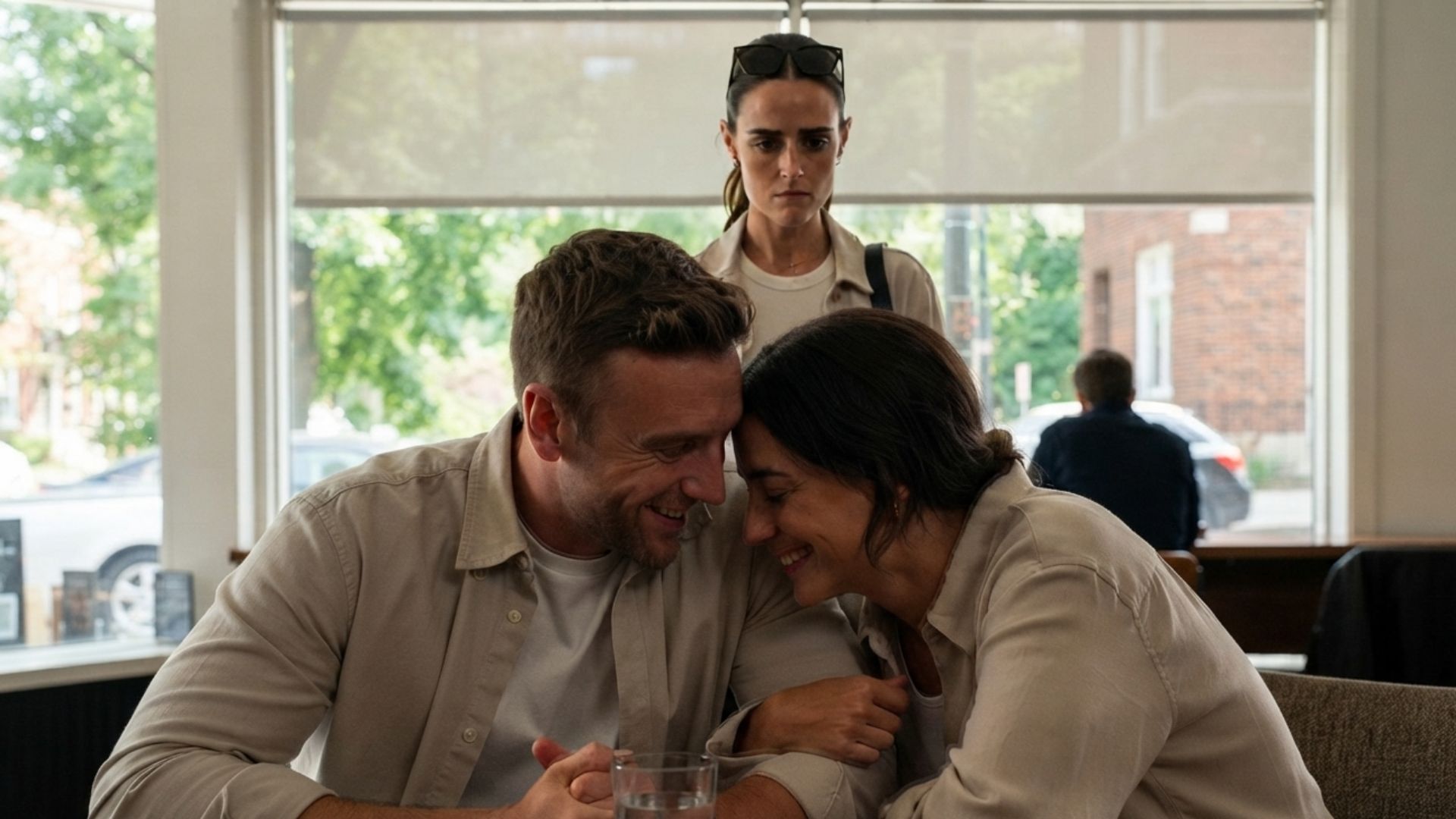
Then she saw the café. Glass front, little round tables, potted plants in the window. The kind of place you went with someone you wanted to impress.
She stopped walking.
Because through the glass, she could see Daniel. And next to Daniel, pressed close enough that their shoulders touched, was a woman with dark hair and a laugh that Maya recognized all the way from the sidewalk.
Cara.
Her best friend since college. Maid of honor. The woman who had helped her pick out her engagement ring style from a magazine cutout eight months ago.
Maya stood on the sidewalk and didn’t move for ten seconds.
“No,” she said quietly. Just to the air. Just to herself.
Then she pushed open the door.
The bell above the door chimed. A few heads turned. Not theirs. They were too deep in whatever they were saying—Daniel’s head tilted toward Cara’s, Cara’s hand on the table inches from his, both of them lit up with something that looked private.
That looked familiar.
Maya crossed the floor. Her shoes were quiet on the tile. Neither of them noticed her until she was standing two feet away, and by then it was too late to rearrange anything.
Daniel looked up first. The color left his face.
“Maya—”
“Don’t,” she said.
Cara turned. Her expression cycled through shock, then guilt, then something that tried to look like innocence and didn’t make it all the way there.
“This isn’t what it—” Cara started.
“What is going on here?” Maya’s voice came out lower than she expected. Steadier. “My fiancé and my best friend. Both of you. Together.”
“Maya, please sit down,” Daniel said. He reached for her hand.
She stepped back.
“I have been driving myself crazy for three months,” she said. “Thinking I was paranoid. Thinking I was the problem. And you two—” She looked between them. “You two have been sitting in cafés.”
“We were just talking,” Cara said.
“Just talking.” Maya picked up the glass of water sitting at the edge of the table — Cara’s glass, still half full. She looked at it for one long second.
“Maya—” Daniel said.
She poured it directly onto Cara’s head.
Cara gasped. Water ran down her hair, down her face, onto the collar of her white blouse. She shoved back from the table, chair scraping loud against tile.
“Are you insane?” Cara snapped, water dripping off her chin.
“Probably,” Maya said. “Six years of trusting the wrong person will do that.”
The café had gone completely silent. A barista behind the counter had stopped mid-pour. Two women at a nearby table stared openly. A man by the window pretended to look at his phone and failed.
Daniel stood up. “Maya, let me explain—”
“How long?” she said.
He closed his mouth.
“How long, Daniel.”
He looked at the table. That was her answer.
“How long?” she said again, louder this time.
“Four months,” he said quietly.
Four months. She had been planning a wedding for four months. She had been talking to a florist, arguing with her mother about venue capacity, choosing between ivory and white for a dress.
Four months.
“Get out of my way,” she said.
She walked out of the café without looking back. She sat in her car for eleven minutes. She did not cry. She called her sister.
“I need you to come over,” Maya said.
“What happened?”
“I’ll tell you when you get there. Bring wine.”
Her sister showed up forty minutes later. Maya had already packed a box — Daniel’s things from her bathroom, his spare key from the drawer, the framed photo from the nightstand that she had always liked more than he did.
She told her sister everything.
Her sister sat quietly through all of it. Then she said, “What do you want to do?”
“I want him out of my apartment,” Maya said. “And I want Cara to know I’m done.”
“Both?”
“Tonight.”
Daniel showed up at nine. He knocked instead of using his key, which told her he already knew the rules had changed.
She opened the door. She did not invite him in.
“Maya,” he said. “Please. Let me explain what it actually was.”
“You had four months to explain it,” she said. “Four months of watching me plan a wedding while you were sneaking around with my best friend. I don’t need the explanation now.”
“It was a mistake. It was—”
“It was a choice,” she said. “You made it over and over again for four months. That’s not a mistake. That’s a decision.”
She picked up the box from the floor beside her and set it in the hallway between them.
“Your key is in there,” she said. “I already called building management about the locks.”
“Maya—”
“I’m not angry anymore,” she said. That part was almost true. “I’m just done.”
She closed the door.
She stood in her kitchen for a moment in the quiet of her own apartment. Then she texted Cara: Don’t contact me. We’re finished.
Cara tried to call twice. Maya sent both to voicemail.
The engagement announcement came down from her Instagram that night. A few people texted. She answered the ones she felt like answering and left the others for tomorrow.
Her sister brought over more wine at ten and stayed until midnight.
“Are you okay?” her sister asked.
“I will be,” Maya said. “I’m better than I was this morning.”
“That’s something.”
“That’s everything,” Maya said.
She poured the last of the wine. Outside, the street was quiet and the city didn’t know anything had happened and the world had not ended.
She had caught them. She had said what she needed to say. She had walked out of that café standing straight and the ring was off her finger and in the box with his key and she had not begged for a single thing.
Three weeks later, she ran into a mutual friend at the grocery store.
The friend hesitated. “I heard about you and Daniel.”
“Yeah,” Maya said.
“Are you—”
“Good,” Maya said. “Actually good.”
The friend studied her face. Nodded slowly. “You look it.”
“I feel it,” Maya said.
She put her basket on the checkout belt and didn’t think about the café, or the sound of a water glass being set down, or the look on Cara’s face when the water hit.
She thought about dinner. She thought about the week ahead. She thought about how quiet and clean her apartment felt now, how she woke up in the mornings without that grinding feeling in her chest that she had spent three months trying to name.
She had named it. She had walked into a café and named it and poured water on it and walked away.
That was enough. More than enough.
The cashier smiled at her and said, “Have a good one.”
“I will,” Maya said.
And she meant it.

Related Posts