A hungry ten-year-old girl ate free pancakes from a stranger every morning for a year… Twenty years later, she walked back into that same café with a briefcase that changed the old waitress’s life forever.
The bread truck driver caught Josie behind the bakery before she got the bag open.
“Hey! Get out of my trash, kid!” He grabbed her wrist, hard enough to bruise. “You want me to call somebody?”
“I’m sorry. I’m sorry, please don’t—”
He shoved her back and she landed on wet concrete, scraping her palm raw. By the time she’d scrambled up, he was already gone, locking the dumpster behind him.
She wrapped her bleeding hand in the hem of her shirt and kept walking. Nobody on the street even slowed down.
Rain hammered the window of the Wren’s Nest Diner. Inside, ten-year-old Josie pressed her hands flat against the glass, watching steam curl off the coffee cups she couldn’t afford.
She had eleven cents in her pocket. Not enough for toast.
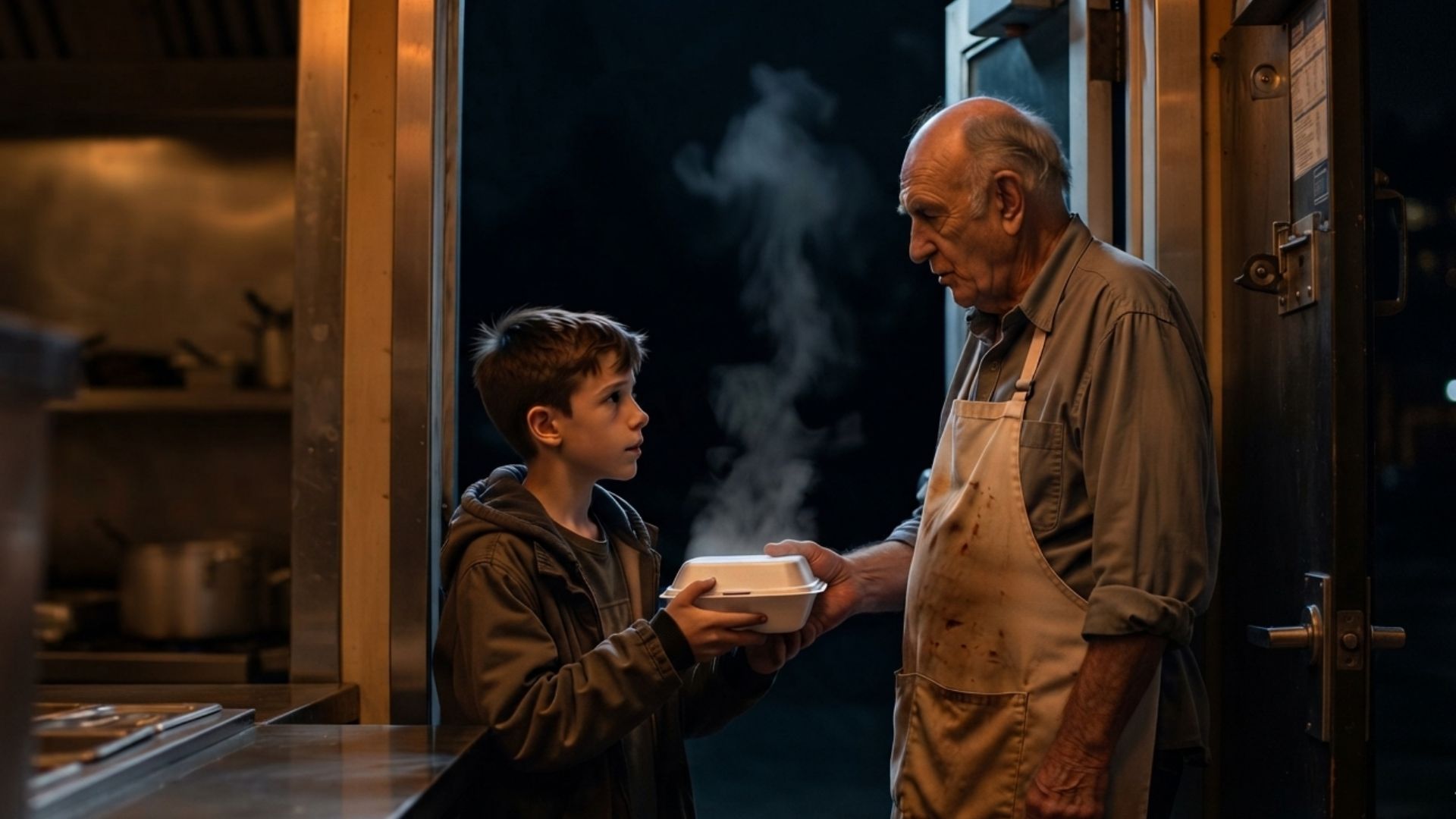
The bell over the door jingled when a waitress with tired eyes and a coffee-stained apron stepped outside on her break. She looked down at the girl huddled under the awning.
“You eaten today, sweetheart?”
Josie shook her head. She’d learned not to trust easy kindness. Kindness usually had a price.
“Come on in out of the rain,” the woman said. “I’m not asking twice.”
“I don’t have money.”
“Did I ask for money?”
That was Ruth Calloway. Forty-one years old, divorced, raising nobody but herself, and about to break the only rule her boss had ever actually enforced.
She sat Josie in the back booth, the one nobody could see from the register. She brought out a plate of pancakes that were supposed to be a customer’s remake.
“Eat slow,” Ruth said. “Nobody’s taking it from you.”
Josie ate like she hadn’t eaten in days. Because she hadn’t.
“Where’s your folks, baby?”
“Don’t have any. Group home didn’t work out. I just… stay around.”
Ruth’s jaw tightened, but her voice stayed soft. “Well. You stay around here tomorrow morning too. Seven o’clock. I’ll have something hot.”
“Why would you do that?”
Ruth shrugged like the answer was obvious. “Because somebody should.”
The next morning, Josie was back. And the morning after that. For eleven months, rain or shine, Ruth slid a plate across that back booth before the sun was fully up.
It didn’t go unnoticed forever.
“Ruth.” Frank Doyle, the owner, cornered her by the coffee station, voice low and sharp. “That’s the third time this week I’ve seen you feeding that street kid on my dime.”
“It’s eggs and toast, Frank. It’s nothing.”
“It’s theft, is what it is. This is a business, not a soup kitchen. You do it again, I dock your pay. You do it a third time, you’re done here.”
Ruth didn’t blink. “Then dock it.”
“Excuse me?”
“Dock my pay. I’ll still feed her.”
Frank stared at her like she’d lost her mind. Maybe she had. A single mother with a mortgage and a bad knee, risking her only paycheck for a kid who wasn’t even hers.
“You’ve got a soft head, Ruth Calloway.”
“Maybe,” Ruth said. “But I’ll sleep fine tonight. Will you?”
He walked away muttering. He docked her twice that month. She never stopped.
Then, on a gray Tuesday in November, two people in county jackets walked into the diner.
“Josie? Josie Marsh?” The social worker crouched to the girl’s level. “We found a placement for you. A good one, this time. Foster family two counties over.”
Josie’s whole body went rigid. “I don’t want to go.”
“Sweetheart, you can’t keep living on the street. This is a real bed. A real family.”
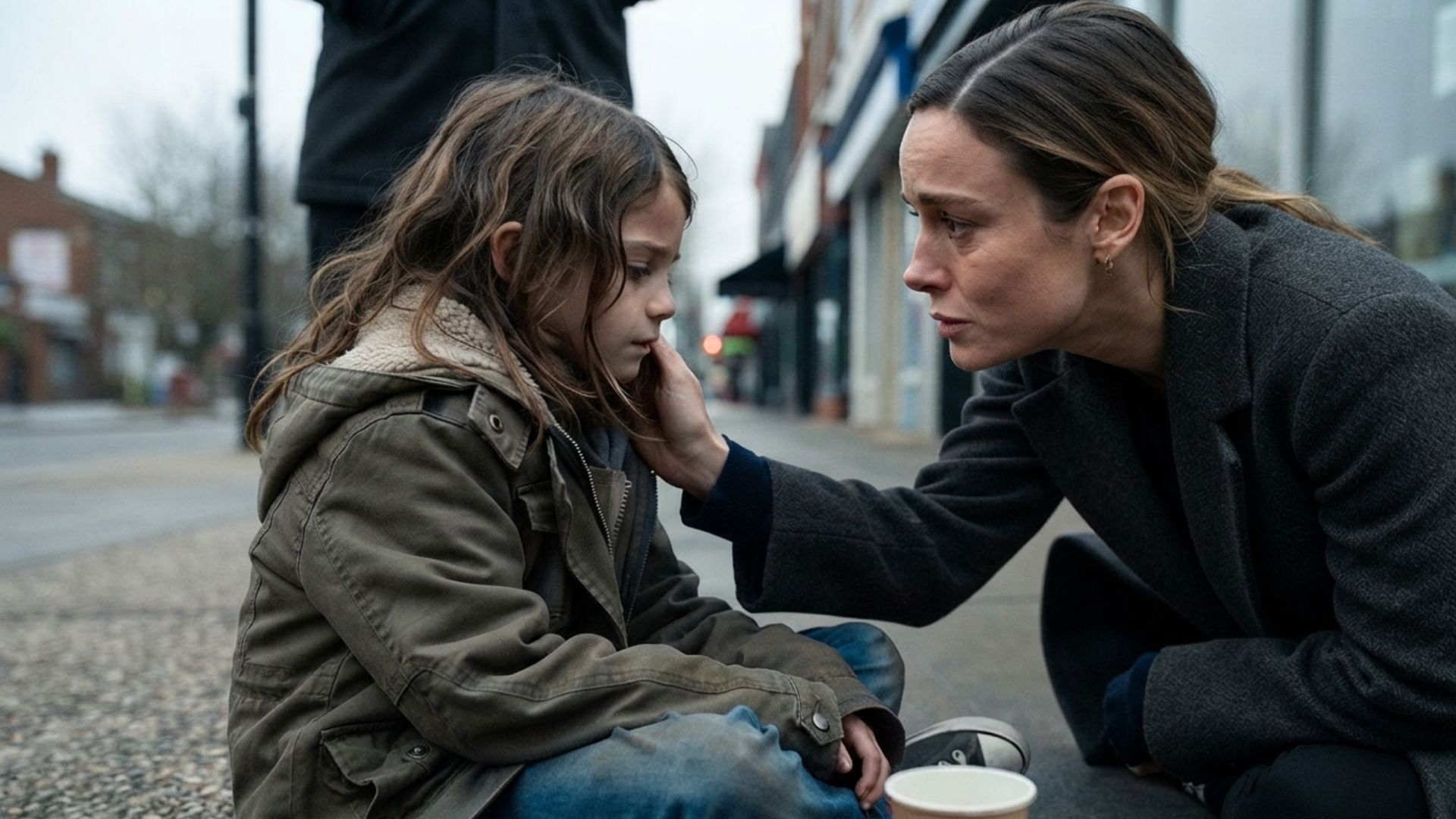
Ruth knelt beside her, throat tight. “Hey. Hey, look at me.” She took Josie’s small hands in hers. “This is a good thing. You hear me? This is somebody finally doing right by you.”
“I won’t see you again.”
“Maybe not for a while.” Ruth’s voice cracked despite herself. “But you remember something for me, okay? You remember that the world isn’t only the bad parts you’ve seen. There’s good in it too. There’s good in you.”
Josie’s eyes filled. She threw her arms around Ruth’s neck, holding on like she was drowning.
“I will never forget this,” Josie whispered. “I promise. I will never forget what you did for me.”
“Go on now, baby.” Ruth pulled back, wiping her own eyes with the back of her wrist. “Go be somebody.”
The social worker led Josie out into the gray morning. At the door, the girl turned around one last time.
“I’ll come back,” she said. “Someday. I promise.”
Ruth watched the car pull away until it disappeared around the corner. Then she went back to work, because the lunch rush didn’t care about broken hearts.
She never told anyone she cried in the walk-in freezer that afternoon. Some things you keep for yourself.
Part Two: Twenty Years
The foster placement two counties over lasted four months before it fell apart, and the one after that lasted barely six weeks. By thirteen, Josie had learned that promises from adults came with expiration dates.
What she hadn’t lost was the memory of a back booth and a plate of pancakes that came with no strings attached.
At fifteen, in her fourth placement — a stable one, finally, with a foster mother named Dee who actually showed up to parent-teacher conferences — a guidance counselor named Mr. Aldous pulled her aside after class.
“Your essay scores are the highest in the school, Josie. Have you thought about college?”
“With what money?”
“With a full-ride scholarship, if you apply yourself the way I think you can.” He slid a folder across his desk. “I’m not going to pretend your life’s been fair. It hasn’t. But you get to decide what happens next. Nobody else.”
She almost laughed at him. Almost told him fairness was a word people used when they’d never gone hungry.
Instead, she took the folder.
“Why are you helping me?” she asked.
“Because somebody should,” he said.
The words hit her like a struck bell. She didn’t tell him why she went quiet, or why her eyes stung. She just nodded and walked out with the folder pressed to her chest like it might be taken from her.
She got the scholarship. Then a second one. She waited tables through college, slept four hours a night through her MBA, and the day she signed the lease on a single-room warehouse with two part-time drivers, she taped a faded photograph to the inside of the door — the only photograph she had of herself at ten, taken by a county caseworker, hollow-cheeked and unsmiling.
She looked at it every morning before unlocking the doors. It reminded her what hunger actually looked like. It made her impossible to satisfy and impossible to discourage.
Josie Marsh became Josephine Hale somewhere along the way — a foster family’s surname, taken on gladly, worn like armor.
She studied on scholarships. She worked three jobs through college. She built a small logistics company out of a garage with two employees and a used delivery van, and twelve years later it had four hundred employees and contracts in nine states.
She never forgot the back booth. She never forgot the woman who fed her when feeding her cost something real.
She just hadn’t found the courage to go back. Not yet. Some debts feel too large to repay casually.
Back in Caldwell, the Wren’s Nest had changed hands. Frank Doyle had passed two years prior, and the diner went to his son, Marcus — a man who saw spreadsheets where his father had seen people.
Ruth Calloway was sixty-three now. Bad knee worse. Same apron, different stains.
“Ruth.” Marcus leaned against the counter one slow Thursday afternoon. “We need to talk.”
“That’s never good news from you.”
“I’ve got an offer. Stratton Group wants to buy the building. Tear it down, put up apartments. Eleven million dollars, Ruth. Eleven million.”
“And the diner?”
“Closes. Obviously.”
Ruth set down the rag she’d been wiping the counter with. “Twenty-six years I’ve worked this floor, Marcus. Your father built half his life on the people I served. What happens to me?”
Marcus didn’t quite meet her eyes. “You’ll get your last paycheck. Two weeks’ severance, like the contract says.”
“Two weeks.” Ruth’s laugh had no humor in it. “Twenty-six years, and you’re handing me two weeks like I’m new hire who didn’t work out.”
“It’s not personal, Ruth. It’s business.”
“It’s always personal when it’s somebody’s whole life, Marcus.” She untied her apron with shaking hands and folded it slowly. “Your father threatened to fire me once for feeding a hungry kid out of my own paycheck. You know what he never did, though? He never once made me feel disposable.”
“The deal closes in three weeks,” Marcus said, already turning away. “I’d appreciate you not making this difficult.”
Ruth stood alone at the counter long after he left, staring at the chipped Formica like it might offer an answer it didn’t have.
She was sixty-three years old with bad knees, no pension worth mentioning, and three weeks before the only home she’d ever really known became a pile of rubble for luxury apartments.
That night, Ruth sat at her kitchen table with a stack of bills and a phone call she didn’t want to make.
“Mrs. Calloway, I understand it’s been a hard year,” her landlord said, not unkindly, but not warmly either. “But I can’t keep carrying a tenant who’s three months behind. I need something by the first, or I have to start the process.”
“I just need a little more time. I’m about to lose my job, Tom. You know that.”
“I’m sorry. I really am. But I’ve got my own bills.”
She hung up and sat in the quiet of her small kitchen, doing math that refused to add up no matter how many times she ran it. Twenty-six years of work, and she was three weeks from losing both her income and her roof in the same month.
She didn’t cry. She’d cried enough for one lifetime. She just turned off the kitchen light and went to bed, because the breakfast shift didn’t care about exhaustion either.
Part Three: The Return
Two states away, Josephine Hale sat in her glass-walled office reviewing a routine real estate brief when a name in the footnotes stopped her cold.
Property: 114 Maple Street, Caldwell. Current tenant: Wren’s Nest Diner. Pending sale: Stratton Group, $11M, redevelopment.
She read it three times before she understood why her chest had gone tight.
“Get me everything on this property,” she told her assistant. “Today. And find out who else is bidding.”
By evening, she had the full picture: an aging building, a desperate seller, a developer circling like it already owned the place — and an employee of twenty-six years who was about to be discarded with two weeks’ pay.
Josephine didn’t sleep that night. She kept seeing a back booth. A plate of pancakes. A woman’s hands wrapping around hers.
This is a good thing, you hear me? There’s good in you too.
She picked up the phone at six the next morning.
“I want to make an offer on 114 Maple Street,” she told her acquisitions lead. “Twelve million. All cash. Close in two weeks. And I want this done through Hale Holdings, not my name. Nobody finds out it’s me. Not yet.”
“Ma’am, that’s two million over the developer’s offer—”
“I’m aware of what it costs,” Josephine said quietly. “Make it happen.”
Eleven days later, Josephine sat in the back seat of a car outside the Wren’s Nest, briefcase on her knees, hands gripping it tighter than necessary.
“You don’t have to do the reveal yourself,” her assistant said gently from the front seat. “I can have legal handle the handoff. You could stay anonymous.”
“No.” Josephine watched the rain bead on the window, the same window she’d once pressed her face against as a girl with eleven cents and nowhere to go. “She needs to hear it from me. She waited twenty years without knowing if I’d ever come back. I’m not making her wait one more day.”
“What if she doesn’t even remember you?”
Josephine almost laughed, except her throat was too tight. “She remembers. People like Ruth don’t forget the ones they save. They just don’t expect to be thanked for it.”
She glanced at the dashboard clock. Still twenty minutes before the lawyers wanted her inside. She told the driver to circle the block once more. She wasn’t ready yet, and she refused to walk in not ready.
That same week, Marcus Doyle sat across from a lawyer he’d never met, watching his eleven-million-dollar deal evaporate in real time.
“I don’t understand,” Marcus said. “Stratton’s offer was solid.”
“Was,” the lawyer said. “A competing buyer came in two million over, all cash, no contingencies. The seller — meaning you — accepted before Stratton could counter. It’s done, Mr. Doyle. The building sold.”
“To who?”
“My client wishes to remain unnamed for now. You’ll meet them at the formal handoff. Friday, ten a.m., at the property itself.”
Marcus didn’t like the sound of that. Not one bit.
Part Four: The Briefcase
Friday morning, the Wren’s Nest smelled like burnt coffee and old grief. Ruth moved through her last scheduled shift like a woman walking to her own funeral, refilling cups for regulars who kept asking if the rumors were true.
“They’re tearing it down, Ruth?” old Mr. Calder asked from his usual stool.
“Looks that way,” Ruth said, voice flat from exhaustion.
At ten o’clock sharp, the bell over the door rang.
A woman walked in without an umbrella, rain still clinging to her shoulders. Mid-thirties, tailored navy suit, a leather briefcase in one hand. She moved like someone used to rooms going quiet when she entered them.
Marcus straightened by the register, plastering on his deal-closing smile. “You must be representing the buyer.”
“I am the buyer,” the woman said.
Ruth glanced up from the coffee pot — and froze.
There was something about the eyes. Something about the way the woman’s gaze swept the diner like she was checking it was all still real.
“Mr. Doyle,” the woman said, setting the briefcase on the counter with a soft, deliberate click. “I have the closing documents here. The building is now property of Hale Holdings. Effective immediately.”
“Right. Of course. We can sign wherever you’d—”
“There’s one more thing.” The woman’s eyes moved past him, to Ruth, and stayed there. “Before we get to signatures.”
Ruth set the coffee pot down with a trembling hand. “Do I… know you?”
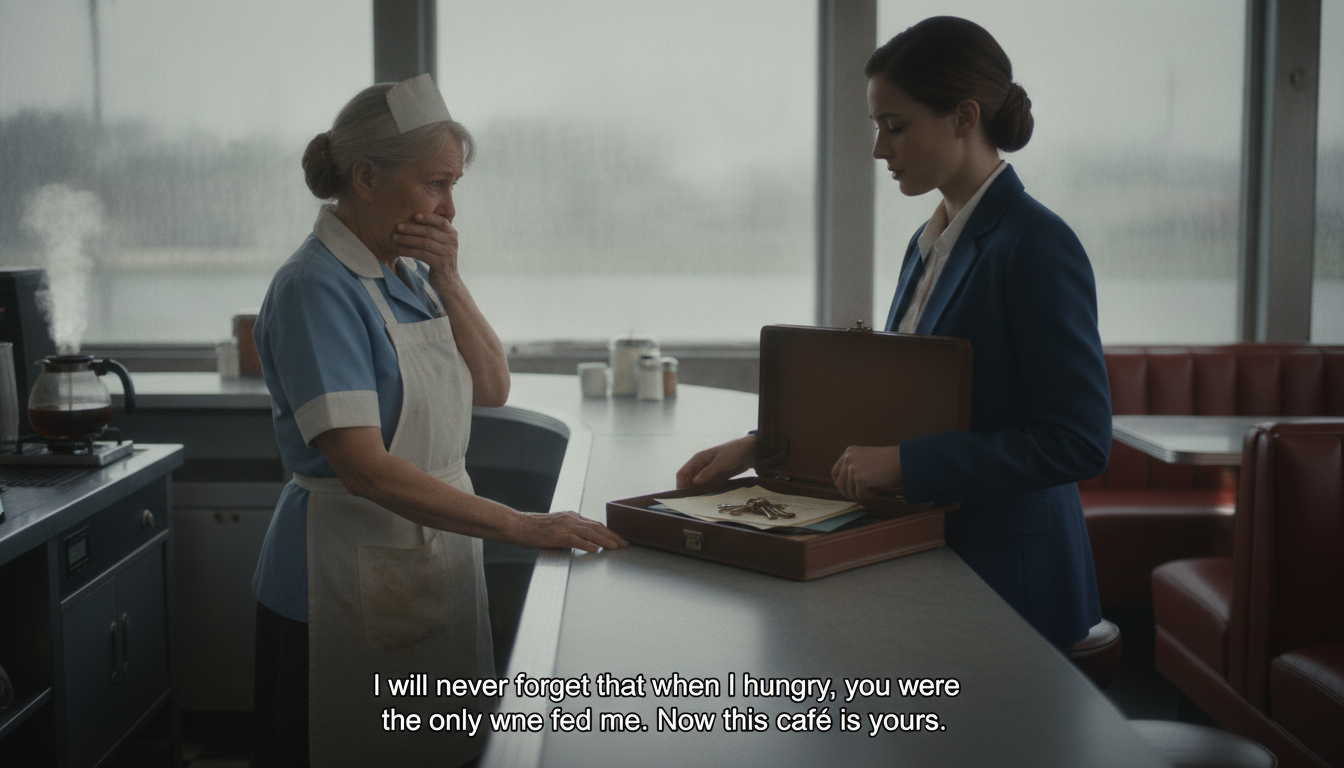
The woman opened the briefcase. Inside, beneath the paperwork, sat a small brass ring of keys.
“Twenty years ago,” she said, voice catching despite her composure, “there was a little girl who used to sit in that back booth.” She nodded toward it. “Eleven cents in her pocket and nowhere to sleep. A waitress fed her every single morning for almost a year. Even when her boss threatened to fire her for it.”
Ruth’s hand flew to her mouth.
“Josie,” she whispered.
“It’s Josephine now,” the woman said, smiling through tears she didn’t bother hiding. “But yes. It’s me.”
The diner had gone completely silent. Mr. Calder set down his fork. Marcus stood frozen, the smile sliding off his face as the math finally landed.
“Wait,” Marcus said. “You’re telling me — you bought my building to give it to her?”
“I bought this building,” Josephine said evenly, “because the woman standing behind that counter gave a starving child everything she had to give, knowing it might cost her job. And then your father’s company spent twenty-six years taking her labor and offered her two weeks’ severance as thanks.” She turned back to Ruth, softening completely. “I will never forget that when I was hungry, you were the only one who fed me. Now this café is yours.”
She lifted the keys and pressed them into Ruth’s shaking palm.
“Mine?” Ruth’s voice broke entirely. “Josie, I can’t—this is—”
“The deed’s already transferred. Full ownership. No mortgage, no debt. Your name on the title, Ruth. Yours.” Josephine pulled a folded document from the briefcase and laid it gently on the counter. “And there’s a standing line of credit attached, for renovations, whenever you want them. I want this place to outlive both of us.”
Ruth was sobbing now, the kind of crying that comes from somewhere too deep to perform. She gripped the keys like they might vanish if she let go.
“Twenty-six years,” she said, “and nobody ever — nobody —”
“I know,” Josephine whispered, pulling her into a tight hug. “I know. That’s why I’m here.”
Marcus stood there, color drained from his face. “I don’t — this doesn’t seem legal. There must be a clause, something I can contest—”
“There isn’t,” the lawyer said flatly from the doorway, having let himself back in to witness the handoff. “Your father’s contract was clear. You sold the building, full stop. What the new owner does with it is entirely her business. As for the severance you offered Ms. Calloway — that’s a separate matter. I’d be careful broadcasting it. Twenty-six years of underpaid overtime tends to interest labor attorneys.”
Marcus’s mouth opened, then closed. For the first time, he looked smaller than the room around him.
“You knew,” he said to Ruth, accusation creeping into his voice. “You knew this was coming.”
“I didn’t know a thing,” Ruth said, wiping her eyes, finally finding her footing again. “I just fed a hungry kid because it was the right thing to do, Marcus. That’s it. That’s the whole secret. Maybe try it sometime.”
Mr. Calder, from his stool, started clapping. Slowly, then louder, the rest of the regulars joined in — a ragged, joyful applause rattling the windows of the little diner that almost wasn’t there anymore.
Marcus grabbed his coat and walked out without another word. Nobody watched him go.
Epilogue
Six months later, the Wren’s Nest had a fresh coat of paint, a repaired roof, and a new sign that still read the same name — because Ruth refused to change it.
The back booth stayed exactly where it had always been. Above it now hung a small brass plaque.
Reserved. Always.
Josephine visited every few months, sliding into that same booth, ordering the same pancakes. Ruth still refused to let her pay.
“Some things,” Ruth said, setting the plate down with hands far steadier than they’d been in years, “you just don’t charge for.”
Josie — Josephine — smiled the way she used to as a girl who’d finally found a place that was warm, and safe, and hers.
“I told you I’d come back,” she said.
“You did,” Ruth said, eyes shining. “And you remembered.”
“I never stopped.”
Outside, the bell over the door jingled as a cold, tired-looking kid wandered in out of the rain. Ruth was already moving toward the back booth before the door had fully closed.
Some promises don’t end. They just get passed on.

Related Posts