A grieving heiress stopped her car for a homeless ten-year-old begging on a Charleston sidewalk… but the girl’s face was an exact match for the daughter she’d buried three years earlier.
Three months. That’s how long Mia Bennett had been alone on the streets of Charleston.
Her parents, Tom and Sarah Bennett, died on a rain-soaked highway in October, the night a delivery truck ran a red light. Mia had been at her grandmother’s that evening. Two weeks later, her grandmother’s heart simply gave out from the grief.
After that, there was no one. A caseworker lost track of her file in the shuffle between two counties. Mia slept behind a laundromat on Meeting Street. She learned which restaurants tossed out food still warm. She learned to keep her head down when men looked at her too long.
By January, she had stopped expecting anyone to stop.
“Spare some change?” she’d ask the lunch crowd, voice flat, eyes already moving to the next person before they answered.
Most days, no one did.
Claire Whitfield stepped out of Roper St. Francis Hospital holding her three-day-old son, Henry, wrapped in a blue blanket monogrammed with his initials. Daniel walked beside her, juggling a diaper bag and a balloon that read “It’s a Boy!” Neither of them was paying much attention to the sidewalk.
That was when Claire saw her.
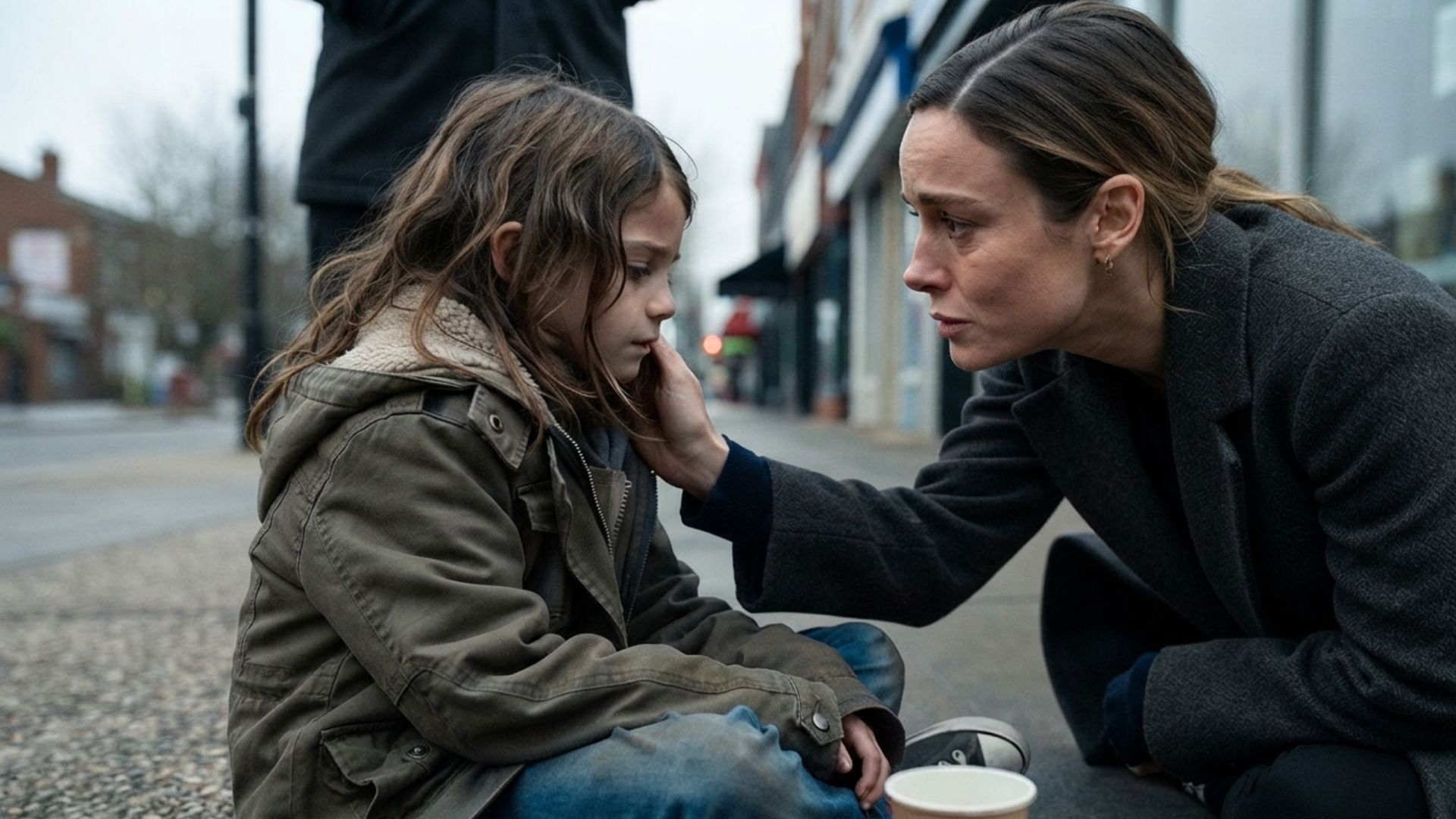
A small girl sat against a brick wall outside a coffee shop, knees pulled to her chest, a paper cup with three quarters in it beside her sneakers. Her dark hair hung over her face, but when she lifted her chin to look at the passing strangers, Claire stopped walking entirely.
“Claire?” Daniel said. “What’s wrong?”
She didn’t answer. She was already crossing the sidewalk.
Claire knelt down in front of the girl, ignoring the cold concrete soaking through her jeans.
“Hi, sweetheart,” she said, her voice unsteady. “What’s your name?”
“Mia,” the girl said quietly, pulling back an inch.
Claire’s eyes filled. The shape of the girl’s face, the exact tilt of her chin — it was like looking through a window into a room Claire had thought was sealed shut forever.
“You look so much like my Isabella,” she whispered, reaching out to smooth the girl’s hair back from her forehead. “You have parents somewhere, don’t you? Someone’s looking for you?”
Mia’s eyes dropped to the cup of quarters.
“No,” she said. “They’re dead.”
Daniel crouched beside his wife, Henry still asleep against his chest.
“Claire,” he said carefully. “We can call someone. Social services, a shelter—”
“No.” Claire pulled Mia into a hug, and after a stiff second, the girl hugged her back, small fingers curling into the fabric of Claire’s coat like she was afraid to let go. “You’re coming with us,” Claire said into her hair. “You’re going to be our daughter.”
Mia went very still. Then, almost too quiet to hear: “Okay.”
Claire stood, lifting Mia’s hand into her own, and turned to her husband. Tears ran freely down her face now, but she was smiling for the first time since the funeral three years ago.
“We found our Iza,” she said. “Let’s go home.”
Daniel looked at the girl, then at his wife’s face — the first unguarded joy he’d seen there in years — and nodded slowly.
“Let’s go home.”
Part Two: Whitfield House
The house on Murray Boulevard had eleven rooms and a view of the harbor. Mia stood frozen in the foyer the next morning, like she expected someone to throw her back out onto the street the moment she relaxed.
“This is yours,” Claire said, opening a bedroom door to reveal yellow curtains and a freshly made bed. “We’ll get you anything you want in here. Furniture, paint, anything at all.”
Mia touched the doorframe like it might not be solid. “I don’t need anything.”
“You need a bed that isn’t a sidewalk,” Daniel said from the hallway, and for the first time since the coffee shop, Mia almost smiled.
It wasn’t simple, of course. There were lawyers within the hour, and a caseworker named Patterson who came by twice that first week, asking Mia gentle, careful questions while Claire hovered in the doorway, unwilling to leave.
“She’s a sweet kid,” Patterson told Claire privately, closing her folder. “But emergency placements like this raise flags. The state will want a full home study before anything’s permanent. And given who you are—” she glanced toward the wing of the house where Daniel’s office sat, “—people are going to talk.”
“Let them talk,” Claire said.
They talked. Within a week, half of Charleston society knew that Daniel and Claire Whitfield — heirs to Whitfield Capital, one of the largest private equity firms on the East Coast — had taken a homeless child off the street and into their home.
At Sunday dinner, Daniel’s mother, Margaret, set her wine glass down harder than necessary.
“A homeless child, Daniel. You don’t know anything about her. Her family, where she came from, what she’s run from.”
“Her family is dead, Mother,” Daniel said.
“That’s what she told you,” Margaret said. “People lie. Especially people with nothing left to lose.”
Mia, seated at the far end of the table, kept her eyes fixed on her plate.
Claire’s hand found Mia’s beneath the tablecloth.
“She’s not a story you’ve decided not to believe, Margaret,” Claire said. “She’s a little girl who lost her parents.”
“And in three weeks, my son’s company has a board vote on the Carolina Trust expansion,” Margaret said. “Investors don’t want headlines about the family being naive. Sentimental, even.”
“Sentimental,” Daniel repeated flatly, jaw tight.
“You know exactly what I mean.”
Mia pushed back from the table. “May I be excused?”
Claire nodded, and the girl disappeared up the stairs, footsteps quiet even in her hurry to be gone.
Part Three: The Whispers
Richard Whitfield, Daniel’s younger brother, had spent six years waiting for a reason.
He’d been passed over for CEO when their father retired — Daniel got the company, Richard got a Senior VP title and a corner office everyone understood was a consolation prize. He’d smiled through it for years. But a scandal involving a homeless street child and the family’s reputation? That was an opportunity he hadn’t expected to land in his lap.
He met Lonnie Voss, a private investigator known for finding things that weren’t always there to find, at a bar off East Bay Street.
“I need everything on this kid,” Richard said, sliding a photo across the table. “Where she came from. Who she ran with on the street. Anything that doesn’t look good in a headline.”
“And if there’s nothing?” Voss asked.
Richard smiled thinly. “There’s always something, if you look hard enough.”
Two weeks later, Mia started at Ashley Hall, wearing a uniform with the tags still cut off that morning. Claire walked her to the car, smoothing down her collar.
“You’ll do great,” Claire said.
“What if the other kids find out?” Mia asked. “About before?”
Claire crouched to her eye level. “Then you tell them you’re Mia Whitfield, and that’s all anyone needs to know.”
Mia nodded, but her hands were shaking when she climbed into the back seat.
That afternoon, Voss called Richard with an update.
“Found something interesting,” he said. “There’s a guy who runs kids on the street corners downtown — takes a cut of what they bring in, assigns them spots to beg. Your girl’s old block was one of his.”
“Was she part of his crew?”
“Hard to say for certain,” Voss admitted. “But it doesn’t really matter what’s true. It matters what people believe when they read a headline.”
Richard was quiet for a long moment. “Send me everything you’ve got.”
Part Four: The Article
The story broke on a Thursday morning, posted to a local gossip blog under the headline: “Whitfield Heir Adopts Street Beggar — Sources Say Girl Was Part of Downtown Panhandling Ring.”
By nine a.m., two local news stations had picked it up. By noon, Whitfield Capital stock had dropped four percent.
Claire found Mia in her room, phone in hand, staring at a photo of herself — taken from across the street weeks earlier, before any of this — captioned with a stranger’s cruel speculation.
“Is it true?” Mia asked, voice small. “Was I part of something bad?”
“No.” Claire took the phone gently and set it face-down on the bed. “Someone is lying about you, sweetheart. And we are going to find out exactly who.”
Daniel stormed into Richard’s office that evening, the printed article slapped down on the desk between them.
“Did you do this?”
Richard didn’t even look up from his monitor. “Why would I do that to my own niece?”
“She’s not your niece yet. And you’ve wanted my office since the day Dad retired.”
“This is beneath you, Daniel. Grief makes people careless. Maybe it’s time someone asked whether you’re thinking clearly about company optics these days.”
Daniel’s jaw tightened until it ached. “Stay away from my family, Richard.”
“Family,” Richard repeated, almost amused. “That’s rich, coming from the man who brought a stranger’s kid into ours overnight.”
“Get out of my way,” Daniel said, “or I’ll make sure the board hears every word of this conversation.”
Richard finally looked up, something cold flickering behind his eyes before he smoothed it away. “Careful, big brother. Glass houses.”
That night, the board convened an emergency session. Margaret, for the first time, didn’t side against Mia — she sat beside Daniel, arms crossed, glaring down anyone who suggested the adoption be “paused for the sake of company optics.”
“My granddaughter is not a press release,” Margaret said coldly. “And anyone in this room who thinks otherwise can go find new investors to charm.”
It was the first time she’d called Mia that word. Mia, listening from the hallway where she wasn’t supposed to be, heard it clearly through the half-open door, and pressed her hand flat against her chest like she could hold the feeling in.
Part Four and a Half: The Schoolyard
By Friday, two news vans were parked outside Ashley Hall.
Claire walked Mia through the side gate, a hand on her shoulder, while a reporter shouted questions from behind a velvet rope the school had hastily put up.
“Mia! Were you part of an organized begging operation? Mia, can you comment?”
Mia kept her eyes forward and her chin level, the way Claire had practiced with her the night before. “You don’t owe them anything,” Claire murmured. “Not even a glance.”
Inside, it was worse in its own quiet way. A girl named Lacey Pruitt cornered Mia by the lockers at lunch, arms crossed.
“My mom says you’re probably a con artist,” Lacey said, just loud enough for the table behind her to hear. “She says rich people get tricked by sad stories all the time.”
Mia set her tray down slowly. “Your mom doesn’t know me.”
“She knows your kind.”
“My kind,” Mia repeated, something steady settling into her voice that hadn’t been there a month ago, “is a ten-year-old who lost her parents. What’s your excuse?”
Lacey didn’t have an answer. She walked away, and for the first time since the article ran, Mia ate her lunch without anyone watching her do it.
That evening, a man Mia recognized from her old block — Daryl, who ran the corner where she used to sit — showed up outside the school gates. Claire stiffened the moment she saw him.
“Mia,” he called out, friendly in a way that made Claire’s skin crawl. “Long time. Heard you landed somewhere nice.”
“I don’t know you,” Mia said flatly, stepping closer to Claire.
“Sure you do. Used to share that corner with you and your folks, before—” He shrugged, almost theatrical about it. “Funny how a reporter tracked me down, asked if you worked for me. I told ’em the truth — never laid a hand on collecting from a kid in my life. But maybe that’s worth something to you. A statement. For a price.”
Claire stepped fully between them. “We don’t pay for statements about lies that were never true to begin with.”
“Your loss,” Daryl said, but he was already backing toward the street, the bluff gone soft the second it didn’t land. Claire watched him go, then crouched beside Mia, whose hands were shaking again for the first time in weeks.
“He doesn’t get to follow you anymore,” Claire said. “Not into this life.”
Part Five: The Proof
Claire couldn’t sleep. At two in the morning she sat at the kitchen island with her laptop, digging through the blog post’s anonymous sourcing, cross-referencing every name Voss had used as an “associate” in his quotes.
Buried in a public filing, she found an invoice for private investigation services — paid not by the blog, not by any tabloid, but by a shell account tracing directly back to a Whitfield Capital expense code.
Richard’s expense code.
She woke Daniel at three a.m., laptop screen glowing between them on the rumpled sheets.
“Look,” she said. “Voss billed eleven thousand dollars to ‘special research services’ under Richard’s department. The same week the story broke.”
Daniel read it twice, his face going pale, then hard as stone.
“He used company money to attack a ten-year-old,” he said quietly.
“There’s more.” Claire scrolled to a screenshotted text thread, recovered from a public data leak tied to Voss’s own carelessness with his servers — texts between Voss and Richard, casual and ugly, written by two men certain no one would ever read them back.
Voss: Found a guy who’ll say whatever we need about the begging ring. Costs extra.
Richard: Whatever it takes. Daniel needs to look reckless before the vote.
“He admits it,” Claire whispered, hand over her mouth. “In writing. He admits all of it.”
Daniel was already pulling on a shirt. “Call Andrea Kim. Tonight. I don’t care what time it is.”
Part Six: The Hearing
The adoption hearing was supposed to be a formality. Instead, it became something else entirely.
Richard’s lawyer tried to argue that the panhandling ring story deserved credibility, that the court should delay the Whitfields’ petition pending “further investigation into the child’s background.”
Andrea Kim stood and placed a single folder on the clerk’s desk without raising her voice.
“Your Honor, we have evidence that the entire panhandling ring narrative was fabricated — and paid for — by the petitioner’s own brother, using corporate funds, in an attempt to derail a board vote and damage his brother’s standing.”
The courtroom went very quiet.
Judge Calloway read through the documents slowly: the invoice, the texts, a sworn statement from Voss himself, who had flipped the moment federal wire fraud charges entered the conversation.
Voss was called to the stand, looking smaller than he had at the bar off East Bay Street.
“Mr. Voss,” Andrea Kim said, “who hired you to investigate the minor child in this case?”
“Richard Whitfield.”
“And did you find any credible evidence connecting her to a panhandling operation?”
Voss shifted in his seat. “No, ma’am. I found a guy willing to say there was one, for a fee. That’s different.”
“Did Mr. Whitfield know the source wasn’t credible?”
“He didn’t care if it was credible,” Voss said. “He cared if it would run before the board vote.”
A murmur moved through the gallery. Richard’s lawyer half-rose to object, then thought better of it and sat back down.
“Mr. Whitfield,” the judge said, looking at Richard over the top of her glasses, “do you have anything you’d like to say?”
Richard’s lawyer leaned in to whisper. Richard said nothing at all.
“I’m referring this matter to the District Attorney’s office,” Judge Calloway said. “Extortion, corporate fraud, and the exploitation of a minor child for the sake of a boardroom vote are not things this court takes lightly.”
Two bailiffs moved toward Richard’s table. He stood slowly, smoothing his jacket like he still believed this could be talked back into order.
“This is absurd,” he said. “She’s not even really my—”
“She’s a Whitfield,” Margaret said from the gallery, rising to her feet, her voice carrying clean across the courtroom. “More of one than you’ve managed to be in years, Richard.”
He was led out through a side door. He didn’t look back once.
Part Seven: Home
The judge granted the adoption that same afternoon, the formality moving quickly now that the obstruction had finally been cleared from its path.
“By order of this court,” Judge Calloway said, “Mia Bennett is hereafter known as Mia Isabella Whitfield, daughter of Daniel and Claire Whitfield, with all rights thereof.”
Mia gripped Claire’s hand so tightly her knuckles went white.
“Isabella?” she whispered.
“Your middle name,” Claire said, crouching down to meet her eyes. “So you’ll always know — you’re not replacing anyone. You’re just ours. All the way through, no conditions.”
That evening, Whitfield Capital released a statement confirming Richard’s termination and the board’s full, unconditional support for the family. The stock recovered within the week. The blog that had run the original story issued a retraction and a quiet apology buried at the bottom of its homepage.
Eleven months later, Richard pled guilty to wire fraud and corporate extortion. He avoided prison on a plea deal, but lost his shares, his office, and his name from every door in the building he’d once walked like he owned it.
At the house on Murray Boulevard, the yellow curtains in Mia’s room had long since been replaced with pale green ones she’d picked herself, because she said the color reminded her of the marsh grass near the harbor.
Henry was eight months old now, and Mia could hold him on her own, no one hovering nearby to make sure she did it right.
“Tell me again,” Mia said one evening, sitting on the porch steps beside Claire, “about the day you found me.”
Claire smiled, looping an arm around her daughter’s shoulders. “I saw you, and for one second, I thought I was looking at someone I’d lost forever. And then I looked again, and I realized I wasn’t losing anyone at all.”
“You were finding someone,” Mia said.
“I was finding someone,” Claire agreed.
Inside, through the window, Daniel watched them with Henry asleep against his shoulder, and thought that for the first time in three years, the house finally sounded like a home again — not because it had been rebuilt to look like what it lost, but because it had room enough to hold something new.

Related Posts