A diner owner noticed a boy skipping his own meal every night to feed someone else… but what he found when he followed him home exposed a landlord’s illegal eviction scheme.
Marcus Hale had owned the diner on the corner of Fifth and Larch for eleven years. He knew most of his regulars by their order, not their name. The man in booth four always got the western omelet, no onions. The woman by the window drank black coffee and tipped exactly fifteen percent, every time.
Then there was the boy.
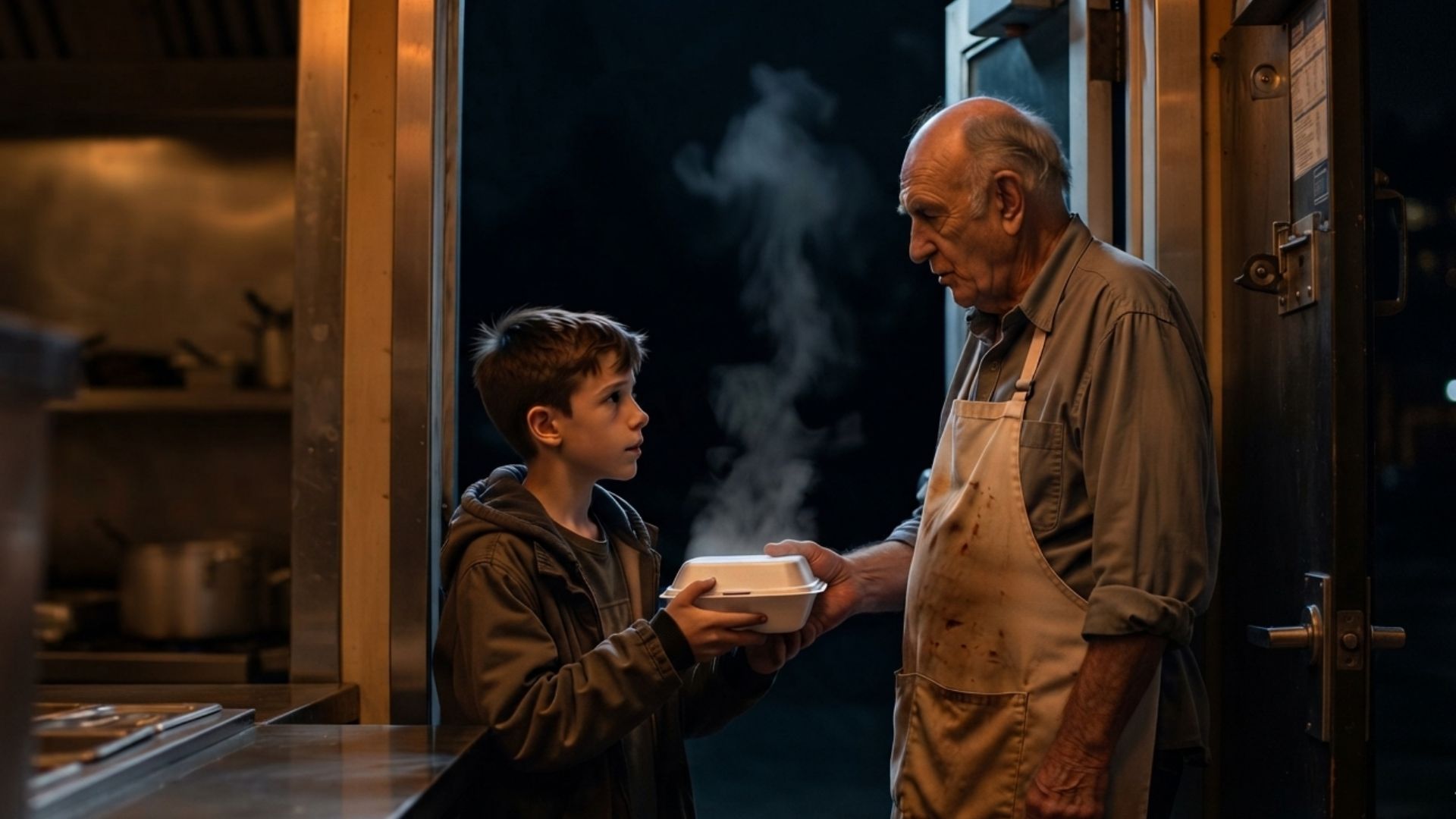
He started showing up about two months ago, always around eight, fifteen minutes before closing. Same booth in the back. Same order.
“Just the soup, please,” the boy said the first night, sliding three crumpled dollar bills across the counter. He couldn’t have been more than eight years old.
Marcus looked at the bills, then at the kid’s worn-out sneakers, the jacket two sizes too big, the way his eyes kept drifting toward the pie case.
“Soup’s two-fifty tonight,” Marcus said, even though it was three-fifty. “Keep the change.”
The boy’s face lit up like Marcus had handed him a hundred dollars. “Thanks, mister.”
“What’s your name, kid?”
“Eli.”
“Well, Eli, you want a roll with that? On the house.”
Eli hesitated. “Could I get it to go? Like, after? In a napkin?”
Marcus frowned. “You can eat it here, bud. It’s warm.”
“I know. I just—” Eli looked down at the table. “Could I save it for later?”
Something in Marcus’s chest tightened, but he just nodded. “Sure thing.”
That night, after Eli left, Marcus stood by the window and watched the kid walk three blocks down Larch and disappear around the corner toward the old brick apartments — the ones the city kept threatening to condemn.
For the next several weeks, it became routine. Eli came in every night, ordered soup, and always asked to take something extra “for later.” A roll. A piece of bread. Once, half a sandwich he barely touched.
Marcus started “forgetting” to charge for the extra. Then he started quietly doubling the portions.
One night, his cook, Donna, pulled him aside. “You know that kid’s been taking food out of here every single night for almost two months, right?”
“I know.”
“You ever wonder where it’s going?”
Marcus wiped down the counter, not looking up. “Kid’s hungry, Donna. That’s all I need to know.”
“Marcus.” Donna crossed her arms. “I think there’s more to it. Kids don’t save bread in napkins unless somebody else needs it more than they do.”
Marcus didn’t answer. But that night, after Eli left with his usual napkin-wrapped roll, Marcus untied his apron, told Donna he’d be back, and followed him.
Eli walked fast, head down, hood up against the cold. Marcus stayed half a block behind, feeling a little ridiculous — a grown man trailing an eight-year-old like some kind of stalker. But something in his gut told him to keep going.
Three blocks became four. Eli cut through an alley behind a laundromat, then up the cracked steps of a squat brick building with a sagging fire escape and a busted intercom panel.
The front door didn’t lock. It just hung open, swollen from water damage.
Marcus waited a beat, then slipped inside after him.
The hallway smelled like mildew and old cigarettes. A single bulb flickered at the end of the corridor. Marcus heard Eli’s sneakers on the stairs — second floor, then a door creaking open.
He climbed the stairs slowly, his heart pounding for reasons he couldn’t quite explain.
Apartment 2C. The door was cracked open, just enough.
Marcus stopped outside it, close enough to hear.
“Gran? I’m back,” Eli said softly.
“Eli, baby, is that you?” The voice was thin, raspy, like it took effort just to speak.
“Yeah, Gran. I brought you something.”
Marcus leaned closer, just enough to see through the gap in the door.
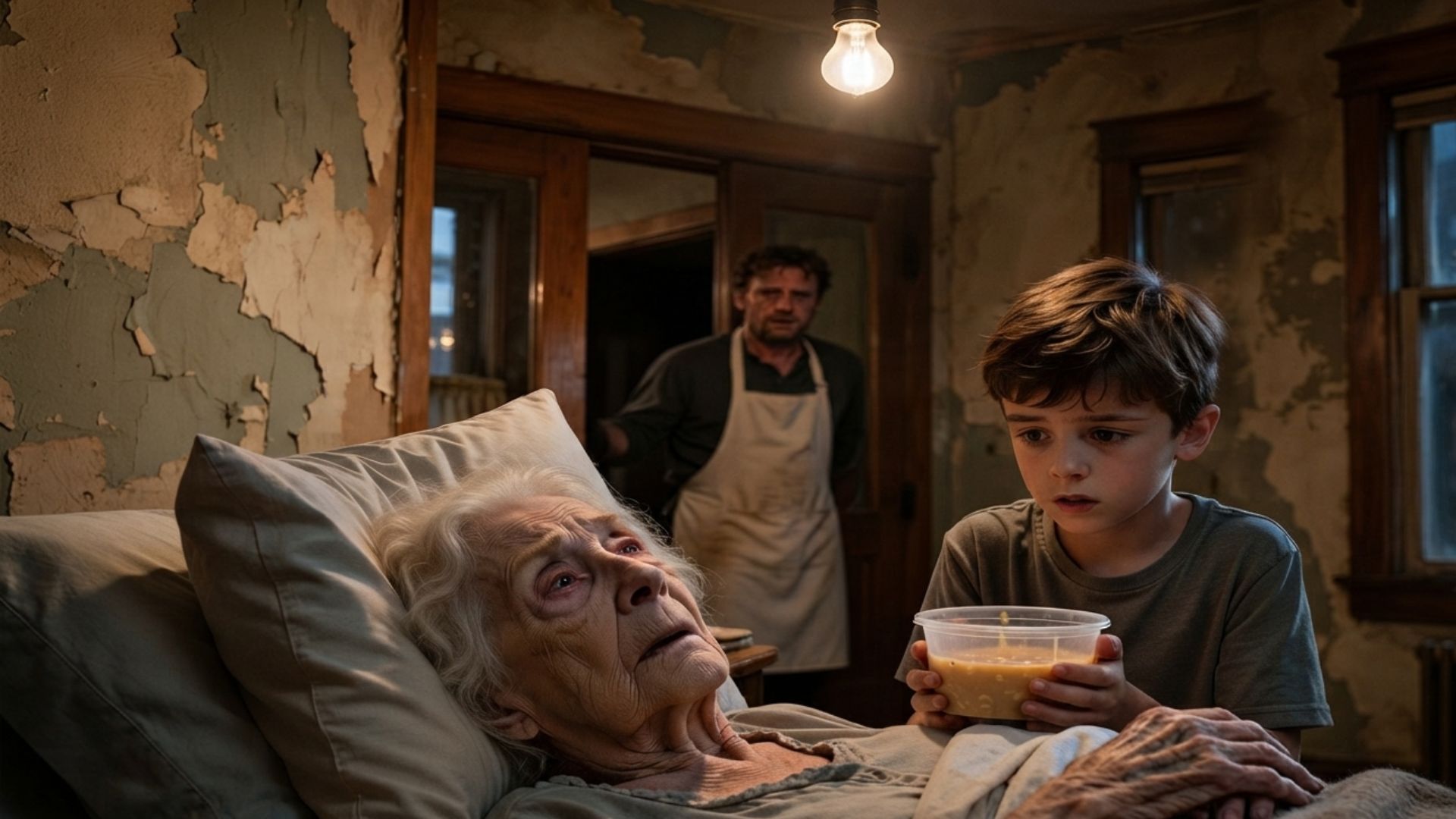
Inside, the apartment was small and dim, lit by a single lamp with no shade. The wallpaper peeled in long curls near the ceiling. A space heater sat in the corner, unplugged, its cord frayed.
On a narrow bed against the wall lay an older woman — thin, gray-haired, a quilt pulled up to her chest. Her breathing sounded labored, wet.
Eli knelt beside the bed and unwrapped the napkin, revealing the roll and, Marcus now realized, a good portion of his own soup, carefully poured into a small plastic container.
“I got soup, Gran. Chicken noodle. Still kinda warm.”
The woman’s eyes filled with tears. “Eli, honey, you didn’t eat?”
“I did, Gran. I had a big bowl. I’m full.” Eli held out the container. “This is for you. You gotta eat so you can get better.”
“Baby, you eat. You’re the one who needs—”
“No, Gran.” Eli’s voice cracked, just slightly, but he held it steady. “Don’t worry about me. I already ate. Please. Just eat this, okay? For me?”
The grandmother’s hand shook as she took the container. “What did I do,” she whispered, “to deserve a boy like you?”
Marcus stood frozen in the hallway, one hand pressed flat against the doorframe. His throat burned. He thought about every night for two months — the napkin, the “for later,” the soup the kid never finished.
He hadn’t been saving food for himself.
He’d been starving himself to feed her.
Marcus pushed the door open.
“Good evening,” he said, his voice rough.
Eli spun around, eyes wide with fear — the kind of fear that comes from years of strangers meaning trouble.
“I—I’m sorry, sir, I didn’t—” Eli started backing toward the bed, like he might need to shield his grandmother.
“Hey, hey.” Marcus held up both hands, palms out. “It’s okay. It’s just me. From the diner.”
Recognition flickered across Eli’s face. “Mr. Hale?”
“Yeah, bud. It’s me.”
The grandmother struggled to sit up, wincing. “Who — who is this, Eli?”
“He owns the diner where I get the soup, Gran.”
“Oh.” The woman’s face went pale with embarrassment. She tried to pull the quilt higher, as if she could hide the bare walls, the broken heater, the whole apartment, behind a square of fabric. “I’m sorry, sir, I didn’t know my grandson was — we don’t usually—”
“Ma’am, please.” Marcus crossed the room and crouched beside the bed, his knees cracking. “You don’t have to apologize for anything.”
He looked at the soup container in her shaking hands, then at Eli, then back at her.
“How long has this been going on? Eli skipping his food for you?”
The woman’s eyes welled up. “I didn’t know. I swear to God, I didn’t know he was doing that.”
“Gran, it’s fine—”
“It is not fine, Eli.” Her voice cracked. “You’re eight years old.”
Marcus introduced himself properly — name, the diner, how long Eli had been coming in. The woman, whose name was Dorothy — “everybody calls me Dottie” — explained the rest in pieces, between coughs that rattled her whole body.
Dottie had raised Eli since he was four, after Eli’s mother — Dottie’s daughter — had died, and his father had never been in the picture. It had just been the two of them ever since, scraping by on Dottie’s small disability check and whatever cleaning work she could pick up.
Six months ago, Dottie got sick. Pneumonia, then something with her heart the doctors wanted to “monitor” but couldn’t really treat without insurance she didn’t have. She’d been to the ER twice, each visit leaving a bill she had no way to pay.
“I can’t work right now,” Dottie said quietly. “And the checks don’t stretch. Not with the rent going up the way it has.”
“Rent’s going up?” Marcus asked.
Before Dottie could answer, a sharp knock rattled the apartment door.
“Pruitt Property Management,” a man’s voice barked from the hallway. “Open up, Mrs. Carver. We need to talk about your balance.”
Dottie’s whole body seemed to shrink into the mattress. “Oh god. Eli, hide the—” She glanced at the soup, at Marcus, at the half-eaten roll, like any of it mattered.
“It’s fine, Gran,” Eli whispered, but his hands were shaking as he set the container on the nightstand.
Marcus stood up and opened the door before anyone else could.
A heavyset man in a polo shirt with “Pruitt Property Management” stitched on the chest stood in the hallway, clipboard in hand. He blinked, clearly not expecting a stranger.
“Who’re you?”
“Marcus Hale. Friend of the family.” Marcus folded his arms. “Can I help you with something?”
The man — Frank Pruitt, according to the embroidery — peered past Marcus into the apartment. “Mrs. Carver’s three weeks behind on rent. Again. I’m here about the notice I left Tuesday.”
“What notice?” Dottie’s voice was small.
Pruitt held up a folded paper. “Rent’s going to fourteen hundred starting next month. Building’s getting renovated — new owners want market rate. You’re at nine-fifty now, which, frankly, you’re already behind on.”
“Fourteen hundred?” Dottie pressed a hand to her chest. “Mr. Pruitt, I can barely make the nine-fifty—”
“Then maybe it’s time to think about other arrangements.” Pruitt’s tone was flat, rehearsed. “I’ve got six units in this building that need to be empty by the end of next month for the renovation crew. I’d hate for this to get complicated.”
“You can’t just—” Marcus started.
“And who exactly are you again?” Pruitt’s eyes narrowed. “Family friend, you said?”
“That’s right.”
“Well, family friend, this is between me and my tenant. I’d appreciate you not getting involved in business that doesn’t concern you.”
Marcus glanced back at Dottie — pale, trembling, one hand still wrapped around a container of soup her grandson had given up his own dinner for — and then at Eli, who was watching the whole exchange with the kind of wariness no eight-year-old should have to carry.
“Actually,” Marcus said, turning back to Pruitt, “I think it concerns me plenty.”
Pruitt’s jaw tightened. “Excuse me?”
“I said it concerns me.” Marcus kept his voice even. “Mrs. Carver’s been a tenant here, what, how many years?”
“Eleven,” Dottie said weakly.
“Eleven years. And now, suddenly, the rent’s going up fifty percent with two weeks’ notice, while she’s recovering from pneumonia and a heart condition?”
“That’s not my problem,” Pruitt said. “I don’t write the laws. New owners set the rates. I just deliver the notices.”
“Then deliver this.” Marcus pulled out his wallet, counted out cash, and held it toward Pruitt. “This covers what’s owed for this month. In full.”
Pruitt eyed the money, then Marcus, suspicion creeping into his expression. “And next month? The month after that? You gonna keep showing up here playing knight in shining armor every time the bill’s due?”
“Maybe I will,” Marcus said. “You got a problem with that?”
Pruitt took the cash, counted it slowly, and stuffed it into his clipboard folder. “No problem at all. Just makes me wonder what your angle is, is all.” He looked at Dottie. “Rent’s still going to fourteen hundred next month, Mrs. Carver. That’s not negotiable. New owners’ decision, not mine.”
He turned and left without another word, his boots heavy on the stairs.
The apartment was silent for a long moment.
“Mr. Hale, you didn’t have to do that,” Dottie finally said, tears slipping down her face. “We’ll figure something out. We always do.”
“Gran’s right,” Eli added quickly. “We’re okay. Really.”
Marcus looked around the apartment — really looked. The space heater that didn’t work. The water stain spreading across the ceiling like a bruise. The single working lightbulb. The cabinet in the corner with maybe four cans of food on the shelf.
“You’re not okay,” Marcus said gently. “And that’s all right. Everybody needs help sometimes. I’m not going anywhere.”
He kept his word.
Over the next two weeks, Marcus showed up at the apartment two or three times after closing — sometimes with groceries, sometimes with a working space heater he picked up secondhand, once with a bottle of children’s vitamins because Eli looked pale.
Dottie protested every time. Every single time, Marcus said the same thing: “Humor an old man. I got nobody to spend money on but my regulars.”
Donna noticed the changes too — the extra orders going out the back door in foam containers, the new softness in Marcus’s face whenever Eli came through the diner doors. She didn’t say anything else about it. She just started adding extra rolls to the bag herself.
Then, on a Tuesday night in late October, Marcus arrived at the apartment to find the building’s hallway freezing — colder than the air outside.
He knocked. Eli opened the door wrapped in two blankets, his breath visible in the air.
“Mr. Hale.” Eli’s teeth were chattering. “Gran’s not doing good.”
Marcus pushed past him. Dottie was curled on the bed, lips tinged faintly blue, the secondhand space heater dark and silent in the corner.
“What happened to the heater?”
“It’s not the heater,” Eli said, voice wobbling. “The whole building’s heat got shut off this morning. The pipes, I think. Mr. Pruitt said it’s a ‘maintenance issue’ and they’re ‘working on it.'”
Marcus pressed his hand to the radiator under the window. Stone cold.
He pulled out his phone and dialed 911.
“I need an ambulance,” he said, kneeling beside Dottie, taking her cold hand in his. “Elderly woman, cardiac history, hypothermia symptoms. 2C, the Larch Street apartments.”
Dottie spent three days in the hospital. The doctors said if Marcus hadn’t called when he did, the cold combined with her weakened heart could have been fatal.
While she recovered, Marcus took Eli back to the diner — fed him a real dinner, no napkins required, and let him do his homework in the back booth while Donna kept an eye on him.
Three days after Dottie came home, there was a knock at the apartment door — different from Pruitt’s, softer, more formal.
Eli opened it to find a woman in a gray blazer holding a leather folder, an ID badge clipped to her lapel.
“Hi there,” the woman said, crouching slightly to Eli’s height. “Is your grandma home? My name’s Ms. Reyes, I’m from Child Protective Services.”
Eli’s face went white. “Is — is something wrong?”
“Nothing’s wrong, sweetheart. I just need to talk to the adults for a few minutes. Is that okay?”
Dottie, propped up in bed with a cardigan over her hospital gown, called out, voice tight with sudden fear. “Eli, let her in, baby.”
Ms. Reyes stepped inside, glancing around — the new space heater humming in the corner, the stocked kitchen shelves, the fresh coat of paint Marcus had put on the water-damaged ceiling two days earlier.
“Mrs. Carver?” she said gently. “I’m sorry to intrude. We received a report — anonymous — alleging that a minor in this household is being left without adequate food, heat, or supervision, and that the grandmother’s medical condition makes her unable to provide proper care.”
Dottie’s hand flew to her mouth. “What? Who would say that?”
“The report was anonymous. I have to follow up on every report we receive, ma’am, it’s standard procedure. I’m not here to take anyone anywhere today — I just need to do an assessment. Can you tell me about your living situation? Income, food access, who’s the primary caregiver?”
Eli grabbed his grandmother’s hand, his small fingers white-knuckled. “She’s a good gran,” he said quickly, voice shaking. “She takes care of me. I don’t want to go anywhere.”
“Nobody’s saying you have to go anywhere, sweetheart,” Ms. Reyes said, but her tone was careful, professional.
Marcus, who’d been in the kitchen putting away groceries, stepped into view. “Ma’am, I don’t mean to intrude, but I think I can help answer some of those questions.”
Ms. Reyes turned, eyebrows raised. “And you are?”
“Marcus Hale. I own the diner up the street. I’ve known this family a few months now.” He gestured around the apartment. “That heater’s new — I bought it Tuesday. Kitchen’s stocked because I restocked it Wednesday. Mrs. Carver was hospitalized last week because the building’s heat was shut off — by the landlord, not because of anything she did. There’s currently a city investigation into the building’s management for exactly that.”
Ms. Reyes’s expression shifted. “An investigation?”
“I can give you the case number,” Marcus said. “And the contact for the housing inspector.” He hesitated, glancing at Dottie. “And I think you should know — this ‘anonymous report’ might not be as anonymous as it sounds. There’s been some retaliation happening around here.”
Ms. Reyes was quiet a moment, then nodded slowly, pulling out a notepad. “I appreciate that. I do still need to do a full assessment — that’s required regardless of where the report came from. But I want to be clear with both of you—” she looked at Dottie, then at Eli, “—a report alone doesn’t mean anything bad is going to happen. My job is to make sure kids are safe. From what I’m seeing right now, in this apartment, today, this doesn’t look like a neglect case to me. But I do have to write it up properly. That takes a little time.”
She spent the next forty minutes asking careful questions — about food, school, medical care, emergency contacts. Dottie answered everything, hands shaking, while Eli sat pressed against her side the whole time, refusing to leave her lap once.
When Ms. Reyes finally stood to leave, she paused at the door. “For what it’s worth, Mrs. Carver — your grandson clearly loves you very much. That counts for a lot, in my line of work.”
After the door closed, Dottie pulled Eli into her arms and held him, both of them shaking, neither one saying anything for a long time.
But Marcus couldn’t stop thinking about one detail from the hospital paperwork: “Reported building-wide heating failure, multiple units affected.”
Multiple units.
The next morning, before the diner opened, Marcus walked back to the Larch Street building and started knocking on doors.
Apartment 1A belonged to an older man named Walt, who’d lived there for nineteen years. “Heat’s been off and on for two months,” Walt said, arms crossed in his doorway. “Every time I call Pruitt, he says it’s ‘being looked at.’ Funny how it’s never actually fixed.”
Apartment 3B was a young mother with two kids. “We got a rent increase notice too,” she said. “Mine went from eight hundred to twelve. The city told me landlords can’t raise rent more than a certain percentage without proper notice, but Pruitt’s office sent some letter calling it a ‘special renovation exception.’ I don’t even know what that means.”
Apartment 4D was empty — padlocked, with a “renovation in progress” sign taped to the door. According to Walt, the family that used to live there had moved out three weeks ago, “real sudden, after their hot water got shut off for like ten days straight.”
By the time Marcus left the building, he had four names, three phone numbers, and a knot of anger sitting in his stomach like a stone.
That afternoon, he called his cousin Carla — a tenant-rights attorney at a legal aid clinic two towns over.
“Marcus Hale,” Carla said when she picked up. “It’s been, what, two years?”
“Carla, I need a favor. And I think it might be a big one.”
Carla drove in the next day. Marcus walked her through everything — Eli, the soup, Dottie, the rent hike, the broken heat, the CPS visit, the empty padlocked unit, the other tenants’ stories.
Carla listened, taking notes, her expression growing darker with every detail.
“Okay,” she said finally. “A few things jump out. One — ‘special renovation exception’ isn’t a real legal category in this state. Landlords can’t bypass rent stabilization rules just by saying the word ‘renovation.’ Two — deliberately shutting off heat or hot water to pressure tenants into leaving is called ‘constructive eviction,’ and it’s illegal. Very illegal. Three—” she tapped her pen against her notepad, “—if that empty unit got vacated because of a manufactured ‘maintenance issue,’ and the same thing is happening across multiple units at once, that’s not bad luck. That’s a pattern.”
“Can you prove it?” Marcus asked.
“Maybe. I’d need documentation — repair requests, dates, anything showing the owners knew about these issues and chose not to fix them. Photos help. Witness statements help more.”
Over the following week, Marcus and Carla quietly built a file.
Walt had saved every maintenance request he’d ever submitted, going back two years — each one stamped “received” by the building’s management office, most never acted on.
The young mother in 3B had a string of texts with Pruitt’s office where she’d asked, in writing, when the heat would be fixed, and gotten only vague non-answers.
Marcus photographed the dead radiator in Dottie’s apartment, the frayed wiring on the old space heater, the water-stained ceiling, the padlocked door of 4D with its suspiciously fresh “renovation” signage — dated, Carla pointed out, the same week the previous tenants had left.
Then there was the rent notice itself, the one Pruitt had handed Dottie. Carla photographed every line of it, including the small print at the bottom — a name. Not “Pruitt Property Management.” A different name. An LLC.
“Sundale Holdings LLC,” Carla read aloud. “I know that name. They’ve bought up three other buildings on this side of town in the last year. Every single one had a ‘renovation’ that somehow involved the heat going out right before tenants left.”
“One more thing,” Carla added, flipping to a fresh page. “That anonymous CPS report. I made a call to a contact at the regional office — they can’t tell me who filed it, but they can tell me the callback number on file.” She paused, tapping the page. “It’s a number registered to Pruitt Property Management’s main office line.”
Marcus felt something cold settle in his chest. “He tried to take her grandson away. Because Marcus paid the rent.”
“Because someone fought back,” Carla said quietly. “That’s what this is, Marcus. This isn’t one bad landlord having a bad month. This is a company with a playbook, and a property manager willing to use a child as leverage to make it work.”
Dottie came home from the hospital — for the second time — on a Friday. Marcus made sure the apartment was warm; he’d bought a second space heater and paid an electrician friend to check the wiring himself. He stocked the kitchen with enough food to last two weeks.
Eli hovered by his grandmother’s side the entire afternoon, refusing to leave even to go to the diner.
“You should go get something to eat, baby,” Dottie said, squeezing his hand.
“I already ate,” Eli said automatically — then, catching himself, managed a small, wobbly smile. “Okay, that’s not true. But I will. Promise.”
Marcus laughed despite himself. Some habits, apparently, took time to unlearn.
That evening, just after six, a knock came at the apartment door — not Pruitt’s familiar rap, but something heavier, more urgent.
Marcus opened it to find two men in matching polo shirts standing behind Pruitt, holding a dolly and a stack of empty cardboard boxes.
“Mrs. Carver,” Pruitt said, holding up a folded paper. “I’ve got a twenty-four-hour notice to vacate, effective as of yesterday. Your time’s up. We need this unit emptied by tonight for the renovation crew.”
“You can’t do that,” Marcus said, stepping into the doorway. “She just got out of the hospital. From hypothermia. Caused by your building’s heat being shut off.”
“That’s a maintenance issue, unrelated to this notice,” Pruitt said smoothly. “This is about unpaid rent at the new rate. Mrs. Carver owes the difference for this month, and frankly, given the history here, the owners have decided not to renew her lease at all.”
“Says who?”
“Says Sundale Holdings,” Pruitt said, and for the first time, there was a flicker of something smug in his voice. “Now, I’d rather not make a scene in front of the kid. So if you could just—”
“Funny you should mention Sundale,” said a voice from the stairwell.
Carla stepped into view, a manila folder tucked under one arm, and behind her — Marcus’s stomach lifted — a man in a city-issued windbreaker with “Housing & Buildings Department” stitched on the chest.
“Frank Pruitt?” the inspector said, glancing at his clipboard. “I’m here following up on three complaints filed this week regarding building-wide heat outages, falsified maintenance logs, and a tenant hospitalized for hypothermia in unit 2C. That ring any bells?”
Pruitt’s smile vanished. “There’s nothing falsified, this is a standard renovation timeline—”
“That’s interesting,” Carla said, opening her folder, “because I’ve got two years of maintenance requests for this building, all marked ‘received’ and ‘pending,’ that never got actioned — right up until tenants started moving out. I’ve also got texts from a current tenant asking about the heat, dated three weeks ago, where your office said repairs were ‘scheduled’ — even though Sundale’s own contractor invoices show no work was ever scheduled for this building. For anything.”
The inspector took the folder, flipping through it with a grim expression.
“There’s one more thing,” Carla said, her voice sharpening. “A formal complaint was filed against this household with Child Protective Services four days ago, alleging neglect — right after Mr. Hale here paid this family’s rent in full and after the heating outage made headlines with the city. The callback number on that report traces to this office’s main line.”
The hallway went very quiet.
“That’s — that’s absurd,” Pruitt sputtered. “Anyone could’ve called from—”
“From the front desk of Pruitt Property Management?” Carla raised an eyebrow. “Sure. Anyone with a key, a badge, and motive.”
“Mr. Pruitt,” the inspector said, “I’m going to need you to hold off on any eviction action tonight. This building is now under active investigation for housing code violations and possible illegal constructive eviction. Filing a false report with a state agency as retaliation against a tenant is a separate matter entirely — and a serious one. Depending on what we find, we’re looking at significant fines, and depending on how this ties back to Sundale’s other properties, possibly revocation of their rental license citywide.”
“You can’t — this is — ” Pruitt looked between the inspector, Carla, and Marcus, his face reddening. “This woman owes rent! That’s a legitimate—”
“The rent increase itself may be invalid,” Carla said calmly, “given t
Behind Marcus, Eli had crept to the doorway, peering out with wide eyes. Dottie sat up in bed, one hand pressed to her chest — not from illness this time, but something that looked almost like disbelief.
Pruitt’s two workers, sensing the shift in the room, quietly set down their boxes and backed toward the stairs.
“This isn’t over,” Pruitt muttered, snatching his clipboard back.
“Actually,” the inspector said, pulling out his radio, “for tonight, it kind of is. Nobody’s getting evicted from this building until we complete our inspection. That includes Mrs. Carver.”
The investigation took six weeks.
By the end of it, the city’s Housing & Buildings Department had documented code violations across all six units of the Larch Street building — and, after cross-referencing complaints from tenants at Sundale Holdings’ other three properties, found the exact same pattern: deferred maintenance, “renovation exception” rent hikes that weren’t legal, and at least two other instances of heat or water being shut off right before a “voluntary” move-out.
Sundale Holdings was fined just over two hundred thousand dollars across its properties, ordered to refund all illegal rent increases with interest, and — the part that made Walt actually whoop out loud in the hallway when he heard — had its rental licenses for all four buildings suspended pending a full safety renovation, funded entirely at the company’s expense, with current tenants guaranteed the right to return at their original rent.
Frank Pruitt was fired within the week. Sundale, eager to distance itself, claimed he’d acted without their “full knowledge.” Carla just laughed when she heard that. “Doesn’t matter,” she told Marcus. “He’s now personally named in a retaliation complaint and a separate complaint for filing a false report with a state agency. He’s not getting another property management job in this state anytime soon — and depending on the DA, he might be dealing with a lot more than a bad reference.”
The CPS case against Dottie was formally closed two weeks later, marked “unfounded,” with a note in the file about the circumstances of the original report. Ms. Reyes called personally to let Dottie know.
“For the record,” Ms. Reyes said over the phone, “I’ve seen a lot of homes in my job, Mrs. Carver. Yours was never one I worried about.”
Dottie’s rent went back to nine-fifty — and stayed there, locked in for the next three years as part of the settlement. The building got new radiators, new wiring, a renovated roof. Apartment 2C got fresh paint and a working heater before Christmas.
But the part that mattered most happened on a Sunday evening, almost two months after that first night Marcus followed a boy home with a napkin full of soup.
Dottie — steadier on her feet now, color back in her cheeks — walked into the diner with Eli, both of them dressed up just slightly, like it was an occasion.
“Evening, Mr. Hale,” Eli said, grinning, sliding into the corner booth. Their booth.
“Evening, bud.” Marcus came around the counter, pulling off his apron. “What can I get you two?”
“Whatever’s good,” Dottie said, settling in across from her grandson. “We’re celebrating.”
“Yeah? What’s the occasion?”
Eli looked at his grandmother, then back at Marcus, grinning wider. “Gran got her first paycheck from the new cleaning job today. The one with actual hours. And a contract. And everything.”
“And,” Dottie added, reaching across the table to squeeze Eli’s hand, “this one finally agreed to order his own dinner. A whole meal. No napkins.”
Eli laughed — a real laugh, easy, unguarded, the kind Marcus hadn’t heard from him in all the months he’d known him.
“Two of the special, then,” Marcus said, his voice a little thick. “On the house.”
“Marcus,” Dottie started, “you don’t have to—”
“I know.” He smiled, already heading for the kitchen. “Humor an old man.”
Behind the counter, Donna caught his eye and gave him a small nod, the kind that didn’t need any words.
Outside, the streetlights flickered on along Larch Street, and for the first time in a long time, every window in the old brick building across the road glowed warm and bright.

Related Posts