She accused her maid of stealing a priceless necklace… But when she opened her own jewelry box, the truth shattered a 22-year-old lie.
The necklace caught the chandelier light when Eleanor Whitmore walked into the drawing room.
She froze in the doorway. Her hand tightened on the silver tray she was carrying.
“Take that off,” Eleanor said. Her voice was very quiet.
The young maid, Clara, looked up from polishing the side table. She was twenty-two, thin, with the kind of tired eyes that came from working two jobs.
“Ma’am?”
“The necklace. Take it off. Now.”
Clara’s hand flew to her throat. Emeralds. Three of them, set between rows of small diamonds. She’d worn it under her uniform collar like she always did. The top button must have come loose while she was bending over.
“Mrs. Whitmore, I can explain—”
“I bet you can.” Eleanor set the tray down so hard the crystal decanters rattled. “Twenty-two years I’ve been collecting estate jewelry. Twenty-two years. And the one piece I could never replace, the one piece I had custom-made, is around the neck of a girl who makes fourteen dollars an hour.”
“It’s not yours.”
“Excuse me?”
“It’s not yours, ma’am. It was my mother’s.”
Eleanor laughed. It was not a kind sound.
“Your mother’s. Of course. Was your mother a Rockefeller, Clara? Was she European royalty? Because I had this designed by a jeweler in Manhattan who only takes three commissions a year.”
“My mother left it to me when she died. I was three.” Clara’s voice cracked but she didn’t look away. “It’s the only thing of hers I have. I wear it under my shirt because I can’t afford to leave it at home. My roommate steals.”
“Take. It. Off.”
“No.”
The word landed like a slap. Eleanor’s mouth opened and closed.
“What did you say to me?”
“I said no, ma’am.” Clara was crying now, but her hands stayed at her sides. “I’ll quit. I’ll leave today. But I’m not giving you my mother’s necklace. You can call the police. I’ll show them the appraisal. My father had it appraised when I turned eighteen.”
“Your father.” Eleanor’s voice had gone strange. Flat. “What is your father’s name, Clara?”
“Daniel Reeves. He raised me alone after—”
“After what?”
“After my mother died. In the car accident. In 2003.”
Eleanor sat down. She had to. Her legs simply stopped working.
“Get the box,” she whispered.
“Ma’am?”
“The velvet box. On the writing desk. The black one. Bring it to me.”
Clara hesitated, then crossed the room. The box was heavier than it looked. She set it on the polished walnut table between them.
“Open it.”
Clara opened it.
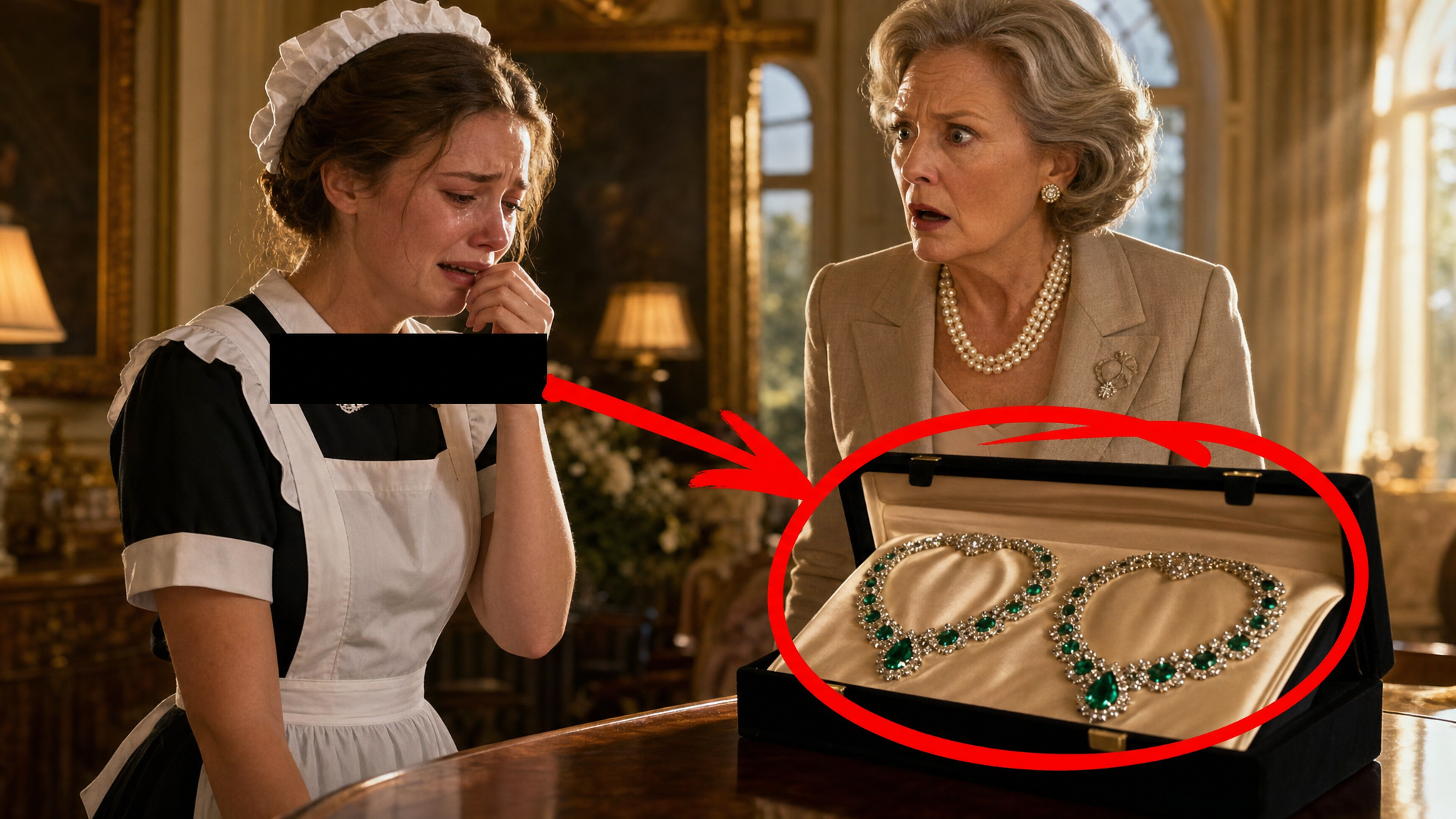
Two necklaces lay on the cream silk lining. Identical. Three emeralds, set between rows of small diamonds. The exact same necklace Clara was wearing. Twice.
“Oh my God,” Clara whispered.
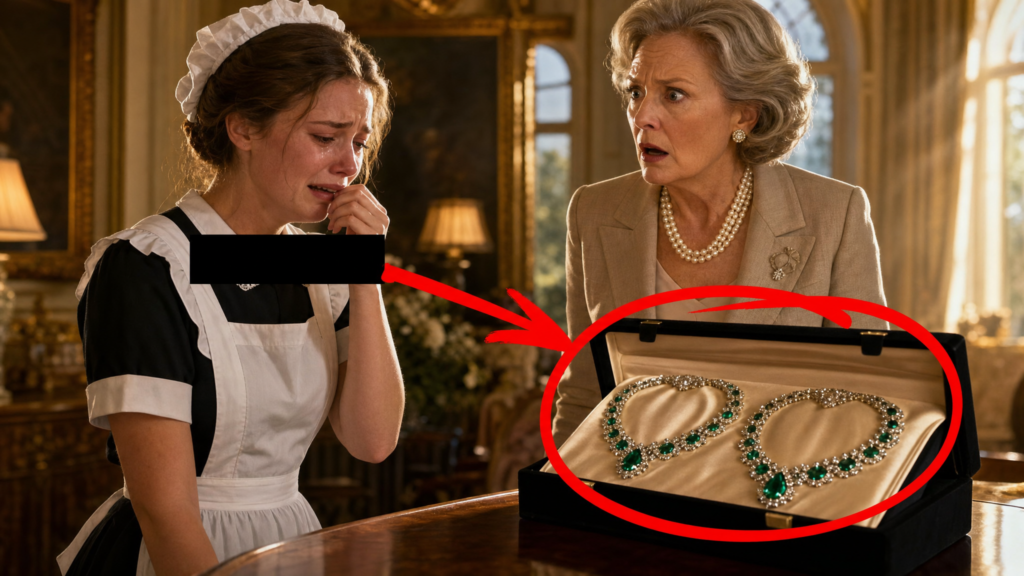
“He had three made.” Eleanor’s voice was somewhere far away. “My husband. Edward. He had three made the year before he died. I always wondered why three. He told me one was a backup, one was for the safe deposit, and one was for me. I never knew what happened to the third.”
“I don’t understand.”
“Sit down, Clara.”
“Ma’am, I have to finish—”
“Sit down. Please.”
Clara sat. The necklace was very heavy against her collarbone now. It had never felt heavy before.
“What was your mother’s name?” Eleanor asked.
“Sarah. Sarah Reeves.”
“Before she married your father.”
“Sarah Whitmore.”
The room went silent except for the hum of the refrigerator three rooms away.
“Edward had a daughter,” Eleanor said slowly. “From before me. He never spoke about her. He told me once, on our third date, that he had made a terrible mistake when he was young and that he wasn’t allowed to fix it. The mother had remarried and the new husband had adopted the child. Edward had signed the papers. He said it was the worst thing he ever did.”
“My father,” Clara said. “My father isn’t—”
“Daniel Reeves adopted you.”
“Yes.”
“And your biological father was Edward Whitmore.”
“I don’t know. I never asked. My dad—Daniel—he said my mom was married before but it didn’t matter, that I was his.”
Eleanor pressed her hand against her mouth. When she pulled it away, her lipstick had smudged.
“Edward died eleven years ago, Clara. He left a will. There was a clause I never understood. A trust. For someone named only as ‘my daughter, should she ever come forward.’ I assumed it was a mistake. I assumed it was him being sentimental about a child he’d given up. The lawyer said the clause expired if no one claimed it within twenty-five years.”
“I’m not claiming anything.”
“I know. I know you’re not.” Eleanor laughed, but it was wet and broken. “You came here to vacuum my floors. You wore your dead mother’s necklace under your shirt and you came here to vacuum my floors and I accused you of stealing.”
“You didn’t know.”
“I called you a thief, Clara.”
“You didn’t know.”
“How did you find this job?”
“The agency. I just took whatever they had. I needed the money. I’m trying to finish nursing school.”
“Nursing school.”
“Yes, ma’am.”
Eleanor stood up. She walked to the window and stood there with her back to Clara for a long moment.
“My son Marcus is forty-six,” she said. “He has been telling me for years that I should sell this house. That I’m rattling around in it like a marble in a tin can. He has two boys in college and one in private school and he is, to put it gently, eyeing my estate like a vulture. He visits me twice a year. He sent me lilies on my birthday last month. I’m allergic to lilies. I’ve been allergic to lilies for forty years.”
She turned around.
“You have a half-brother, Clara. He is not a good man.”
“Mrs. Whitmore—”
“Eleanor. My name is Eleanor.”
“Eleanor. I don’t want anything. I swear to God I didn’t know. I’ll leave. I’ll never come back. You can keep the necklace if you want, I don’t—”
“Stop.”
Clara stopped.
“You are not leaving. You are not giving me that necklace. You are going to sit there and you are going to drink the tea I’m about to make you and you are going to tell me everything about your mother. Every single thing you remember.”
“I don’t remember much. I was three.”
“Then tell me the small things. The smell of her perfume. A song she sang. Anything.”
Clara swallowed.
“She used to call me ‘little bird.’ My dad told me that. She’d say good morning, little bird.”
Eleanor closed her eyes.
“Edward used to call me his sparrow,” she said. “I always thought it was just a pet name.”
There was a long silence.
“Stay there,” Eleanor said. “Don’t move. I’m calling my lawyer.”
“Eleanor, please. I don’t want—”
“I know you don’t want anything. That is precisely why you are going to get everything. Now sit.”
She picked up the phone.
The lawyer arrived ninety minutes later. His name was Howard Greer and he had been Edward Whitmore’s attorney for thirty-one years. He was seventy years old and walked with a cane and he stopped in the doorway when he saw Clara at the kitchen table eating a sandwich Eleanor had made her.
“My God,” he said. “She has Edward’s eyes.”
“You knew?” Eleanor said.
“I suspected. There was a payment, Eleanor. Every month for fifteen years. To a Sarah Reeves, then to a Daniel Reeves after Sarah passed. I asked Edward once. He told me to mind my business and double my fee.”
“You didn’t tell me.”
“He was my client. Not you. I’m sorry, Eleanor. Truly.”
Howard set his briefcase on the table and pulled out a folder so thick it was bound with two rubber bands.
“The trust is real,” he said. “Edward funded it the year before he died. It has been accruing interest since 2014. The original deposit was one point two million dollars.”
Clara made a small sound. Like a hiccup.
“With interest and reinvestment,” Howard continued, “the trust currently holds approximately four point six million dollars. It is yours, Clara, if you can prove biological relation. Which, given the necklace and the timeline, will be a formality. A cheek swab. Nothing more.”
Clara put down the sandwich. Her hand was shaking.
“I don’t want it.”
“Yes, you do,” Eleanor said gently. “You’re going to finish nursing school. You’re going to pay off whatever debt you have. You’re going to sleep somewhere your roommate doesn’t steal. And then we are going to have a much longer conversation.”
“Mrs. Whitmore—Eleanor—your son—”
“My son is going to be very upset,” Eleanor said. “Howard, what does this do to Marcus’s portion of my estate?”
Howard cleared his throat.
“The trust from Edward is separate. It does not affect your estate. However, your estate, Eleanor, is yours to distribute as you see fit.”
“Good. Draft new papers tomorrow. Marcus gets the lake house. Clara gets everything else.”
“Eleanor!” Clara’s voice rose. “No. No, you can’t, you don’t even know me—”
“I know you wore my husband’s necklace under your shirt for twenty-two years because it was the only piece of your mother you had left, and when I screamed at you, you didn’t scream back. I know everything I need to know.”
Howard was writing in his notebook.
“There is one more matter,” he said, not looking up. “Marcus called my office last week. He asked about your competence, Eleanor. He inquired about the procedures for a conservatorship hearing.”
Eleanor went very still.
“He what?”
“He framed it as a hypothetical. He’s been speaking with another attorney. I would not have told you, except—” Howard glanced at Clara. “Except the circumstances have changed.”
Eleanor sat down at the kitchen table. She looked at Clara across the sandwich and the tea and the open folder full of her dead husband’s secrets.
“Well,” she said. “Marcus picked the wrong week.”
She picked up the phone.
Marcus arrived the next morning in a charcoal suit. He had been told there was a family emergency. He walked into the drawing room expecting to find his mother in distress and instead found her sitting beside a young woman in a maid’s uniform, both of them drinking coffee, with Howard Greer in the chair across from them.
“Mother. What is going on.”
“Sit down, Marcus.”
“Who is this?”
“Sit down.”
He sat. Clara could not look at him. He looked too much like the photograph of Edward Whitmore on the mantelpiece.
“Marcus, this is Clara Reeves. She is your half-sister. Your father had an affair before he met me. Clara is the result. He provided for her in a trust that has just been activated. Howard has the paperwork.”
Marcus stared. He laughed once, sharply.
“This is a joke.”
“It is not.”
“Mother, this girl is a maid. In your house. You expect me to believe—”
“DNA test confirms it,” Howard said evenly. “Cheek swab was processed this morning by a private lab. Ninety-nine point nine eight percent.”
“You did this overnight?”
“We had her father drive in from Albany. He kept Edward’s letters. He brought them this morning. We expedited the lab. Eleanor paid for rush processing.”
Marcus turned to his mother.
“Mother. Please. We need to talk privately. This girl is taking advantage of you.”
“This girl,” Eleanor said, “told me to keep the necklace and walk away. Twice. I have never met anyone less interested in my money in my entire life. Including, I’m afraid, you.”
“What is that supposed to mean?”
“Howard.”
Howard slid a piece of paper across the coffee table. Marcus picked it up. His face changed slowly. First confusion. Then recognition. Then a kind of pale stillness.
“Where did you get this.”
“You filed it, Marcus. You filed an inquiry with Judge Hartwell’s office last Thursday regarding conservatorship procedures for a family member showing signs of cognitive decline. You used my full name. The clerk is a friend of Howard’s daughter.”
“Mother, I was just—”
“You were just trying to have me declared incompetent. So you could control my estate. Before I could change my will.”
“That is not—”
“I changed it this morning, Marcus.”
The silence was enormous.
“You get the lake house,” Eleanor said. “It’s worth eight hundred thousand. It is more than fair, given that you have not visited me without asking for something in nine years. Clara gets the rest.”
“You can’t be serious.”
“I am extraordinarily serious.”
“She’ll contest it. The minute you’re gone, she’ll—”
“I won’t,” Clara said. She finally looked up at him. Her eyes were Edward’s eyes. He saw it the same moment Howard had. “I told her not to do it. I’m telling you now. If she gives me anything, I’ll split it with you. I don’t want a fight.”
Marcus stared at her.
“Why?”
“Because I know what it’s like to lose a parent and feel like nobody cared. I’m not going to do that to you. Even if you tried to do it to her.”
“I wasn’t trying to—”
“Marcus.” Eleanor’s voice was very soft. “Stop. You are embarrassing yourself.”
He stood up. He put the paper back on the table with hands that were shaking very slightly.
“I’ll see you in court, Mother.”
“You will not. Howard has prepared a competency evaluation, completed this morning by Dr. Patel, who you may recall is the head of geriatric psychiatry at Mount Sinai. I am, in his professional opinion, of entirely sound mind. Should you attempt a conservatorship action, the evaluation will be entered into evidence, along with the record of your inquiry to Judge Hartwell. Any judge in this state will see what you tried to do.”
Marcus opened his mouth. Closed it.
“Get out of my house, Marcus. Come back when you can apologize. Properly. To both of us.”
He left without another word. The front door closed behind him with a soft, expensive click.
Eleanor exhaled.
Clara was crying again. Quietly, this time.
“I’m sorry,” Clara whispered. “I’m so sorry I came here.”
Eleanor reached across the table and took her hand. It was the first time she had touched her.
“Sweetheart,” she said. “You came home. You just didn’t know it.”
Six months later, Clara graduated from nursing school. Eleanor was in the third row, in a beige suit, holding a small bouquet of sparrows—the florist had laughed when she’d asked, but had managed to find them, tiny brown birds woven from straw, tucked among the white roses.
Daniel Reeves sat beside her. He had been nervous to meet Eleanor. He had wept the first time, in her kitchen, when she’d thanked him for raising Edward’s child better than Edward ever could have.
Marcus did not come.
But three weeks after the graduation, a letter arrived at the house. It was short. Two paragraphs. He apologized to his mother. He apologized to Clara. He did not ask for anything.
Eleanor read it twice and put it in the drawer with Edward’s letters.
“He’s trying,” she told Clara that night, over dinner.
“That’s all anyone can do.”
Clara reached up and touched the necklace at her throat. She wore it openly now.
“Mom would have liked you,” she said.
Eleanor smiled. Her eyes were wet.”I think I would have liked her too, little bird.”

Related Posts