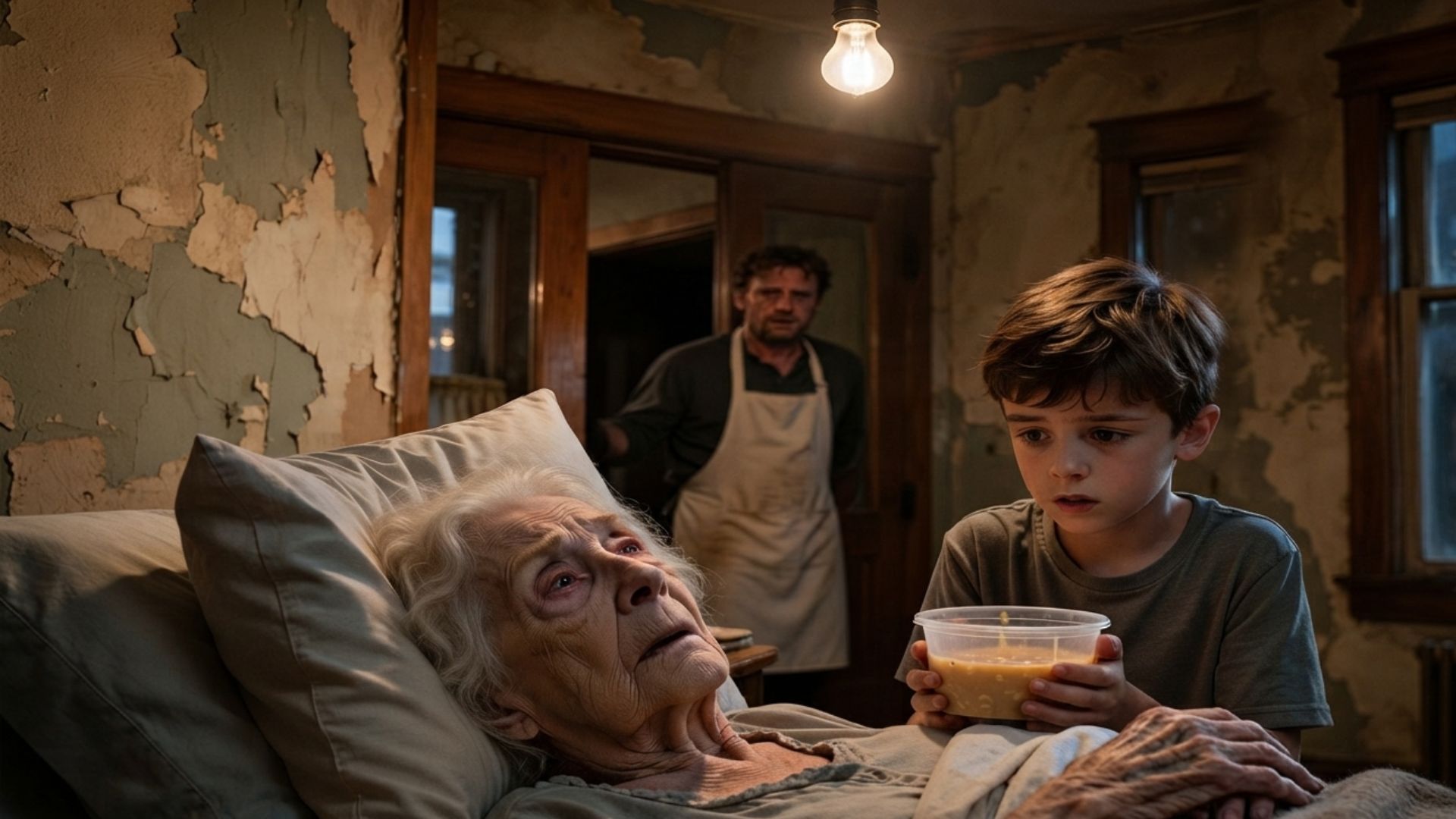

A diner owner secretly fed a hungry boy every night for months… But following him home uncovered a missing $230,000 trust fund — and the uncle who’d been stealing it.
Frank Doyle had owned the Blue Plate Diner on Route 9 in Millbrook, Ohio, for twenty-six years.
He knew every regular’s order, every waitress who’d ever quit on him, and every excuse a customer gave for dodging a tip.
What he didn’t know — not for the first two months — was the name of the boy who showed up at the back door every night, right after closing.
“You’re late,” Frank said one evening, holding the door open with his hip.
“Sorry, Mr. Doyle. Had to wait till my grandma fell asleep.”
Frank slid a foam container across the steel counter. “Pot roast. Eat it before it gets cold.”
“Thank you, sir.” The boy tucked the container under his thin jacket like it was something fragile.
“You always say that,” Frank said. “Same two words, every night, for two months straight.”
“It’s polite,” the boy said.
“It’s also weird for a ten-year-old. Most kids your age don’t say ‘sir’ unless their mom’s standing right behind them threatening ’em.”
The boy — Eli, Frank had learned, after the third week of asking — just smiled and disappeared into the dark.
Frank stood in the doorway a long moment, the cold air biting at his face.
Something about that smile didn’t sit right with him. It wasn’t a kid’s smile. It was a grown man’s smile — the kind that says thank you and please don’t ask any more questions at the same time.
That night, Frank didn’t go straight home.
He told his cook, Marisol, he’d lock up.
“You sure?” she asked, pulling off her apron. “You never lock up. You hate locking up.”
“I got something to take care of.”
“Something, or someone?” Marisol smirked, nodding toward the back door. “That kid?”
Frank didn’t answer. He just grabbed his coat.
He followed Eli at a careful distance — half a block back, sticking to the shadows between streetlights.
Eli walked fast, head down, container clutched against his chest like he was protecting it from the wind.
Three blocks. Then four. The streetlights got sparser. The houses got smaller, the paint peeling like old sunburns.
Eli cut through a gravel lot behind a row of low apartment buildings — the kind with plywood over a couple of windows and a dumpster that hadn’t been emptied in weeks.
He stopped at a door on the end unit. Ground floor. No porch light.
Frank stayed back by the dumpster, half-hidden, feeling like a fool — a fifty-eight-year-old man hiding behind garbage to spy on a ten-year-old.
But something kept his feet planted.
Through a thin curtain, Frank could see movement. A lamp, low and yellow. No overhead light — just the lamp.
He crept closer. Close enough to hear voices through the gap in the window frame.
“Eli? That you, baby?” An older woman’s voice, tired and thin.
“Yeah, Grandma. I’m home.”
“You’re so late. I was startin’ to worry.”
“I had to help clean up at the diner. Mr. Doyle let me stay a little extra.”
Frank’s jaw tightened. Mr. Doyle let me stay a little extra. The kid was protecting him — making sure nobody asked questions about a diner owner giving out free food.
Through the gap, Frank watched the boy set the container down on a card table that served as a kitchen table.
Two smaller kids were already asleep on a mattress in the corner — a boy and a girl, maybe five or six, tangled together under a blanket that looked more like a beach towel.
The grandmother — gray-haired, hunched, wrapped in two sweaters even though it wasn’t that cold outside — sat in a folding chair near the lamp.
“Eli, honey, sit down. Eat something. You must be starving.”
“No, Grandma. You eat. I’ve already eaten.”
Frank felt something twist in his chest.
The boy hadn’t eaten a single bite of that pot roast. He’d carried it four blocks, in the cold, past his own hunger, just to put it in front of his grandmother.
“Eli—”
“Please, Grandma. I had a big dinner at the restaurant. Mr. Doyle gives me extra ’cause I help clean up. I’m full. Really.”
The lie came out smooth. Practiced. Like he’d said it a hundred times before.
The grandmother — Ruth, Frank would later learn — finally picked up the fork.
“Okay, baby. If you’re sure.”
“I’m sure.”
She ate slowly, like she hadn’t eaten all day either. Eli sat across from her, watching, smiling — that same too-old smile Frank had seen at the diner.
When she finished, she pushed the empty container toward him. “Lick the gravy, at least. Don’t waste it.”
Eli took it, and for just a second, his composure cracked — he scraped the last bit of gravy with his finger and ate it fast, like he didn’t want anyone to see how badly he’d needed it.
Frank had seen enough.
He turned and walked back to his truck, hands shaking — not from the cold.
He didn’t sleep that night.
He kept seeing it — the boy’s finger scraping the foam container. The grandmother’s eat something, baby. The lie, told so gently, so many times it had worn smooth like a river stone.
At 5 a.m., Frank was already at the diner, packing two grocery bags full of eggs, bread, milk, fruit — whatever he had on hand.
Marisol found him there when she came in for the morning shift.
“Frank? You look like hell. You sleep at all?”
“Not really.”
“What’s with the groceries?”
“I followed the kid home last night.”
Marisol’s face changed. “And?”
“And I think that family needs more than leftovers.”
That afternoon, Frank drove back to the apartment complex — this time in daylight, this time at the front door, knocking like a normal human being instead of hiding behind a dumpster.
The door opened a crack. Ruth peered out, one eye visible through the gap.
“Yes?”
“Mrs.—I’m sorry, I don’t know your last name. I’m Frank Doyle. I own the diner where Eli comes by sometimes.”
Ruth’s face went pale. “Is he in trouble? Did he do something?”
“No, no — nothing like that. He’s a good kid. I just… I wanted to bring some groceries by. That’s all.”
Ruth stared at the bags in his hands, then at his face, like she was trying to figure out the catch.
“We don’t take charity, Mr. Doyle.”
“It’s not charity. It’s groceries. Groceries that were gonna sit in my walk-in and go bad anyway.”
Ruth hesitated, then stepped back to let him in.
The apartment was even smaller than it had looked from outside. One room, really — a kitchenette, the mattress in the corner where the twins were now awake watching cartoons on a cracked phone screen, and a card table with two folding chairs.
A space heater sat in the middle of the floor, unplugged.
“Why isn’t that running?” Frank asked, nodding at the heater.
Ruth’s mouth tightened. “Electric got shut off two weeks ago. We’ve been using candles and a battery lantern.”
“Two weeks? In this cold?”
“We manage.”
Frank set the bags on the counter. As he did, his eyes landed on a piece of paper taped to the inside of the door — a bright orange notice.
NOTICE TO VACATE — 5 DAYS
Frank’s stomach dropped. “Ruth. What is this?”
Ruth’s shoulders sagged, like the question itself was a weight. “Landlord says we’re three months behind. Says if we don’t catch up by Friday, he’s changing the locks.”
“Three months behind on what — how much are we talking?”
“Eleven hundred dollars. Might as well be a million.”
“How does a family with three kids end up here?” Frank asked gently, sitting down at the card table across from her. “If you don’t mind me asking.”
Ruth was quiet for a moment, looking at the twins on the mattress.
“My daughter — Eli’s mom — and her husband died two years ago. Car accident on the interstate. Drunk driver crossed the median.”
“I’m so sorry.”
“There was a settlement. Insurance money. Enough to take care of these kids ’til they’re grown, if it’s managed right.”
“So what happened to it?”
Ruth’s jaw clenched. “My son. Dale. He’s the trustee. Said he’d ‘handle the finances’ so I wouldn’t have to deal with the stress. Said it was easier that way, with my arthritis and all.”
“And?”
“And for two years, I’ve gotten exactly four hundred dollars a month. For three kids. Meanwhile Dale just bought himself a new truck.”
Frank felt heat rise in his chest — not at Ruth, but at a man he’d never met.
“Have you asked him about it? About the truck, the money?”
“Every time I call, he says the trust has ‘restrictions.’ Says the lawyers set it up that way, says he can’t just hand out cash whenever I ask. Says I should be grateful he’s even bothering with all the paperwork.”
“Do you have any of that paperwork? Statements, anything?”
Ruth shook her head. “Dale handles all that. Says it’s easier if he keeps it all together. I get a check in the mail. That’s it.”
Just then, the apartment door opened, and Eli walked in from school, backpack hanging off one shoulder.
He froze when he saw Frank sitting at the table.
“Mr. Doyle?”
“Hey, Eli.”
Eli’s eyes went wide, darting between Frank, his grandmother, and the grocery bags. “Did I — did I do something wrong? Are you mad I told you Grandma’s name—”
“No, buddy. Nothing like that.” Frank stood, suddenly aware of how this must look to a ten-year-old — like getting caught in some kind of trap. “I just wanted to bring some groceries by. That’s all.”
Eli looked at Ruth, silently asking if it was okay.
Ruth nodded, eyes wet. “It’s okay, baby.”
That night, Frank couldn’t stop thinking about the eviction notice.
Five days.
He called the only lawyer he knew personally — Diane Cole, a regular at the diner who came in most Thursdays for the meatloaf special and always tipped twenty percent even on a six-dollar coffee.
“Diane, it’s Frank. From the Blue Plate.”
“Frank! Everything okay?”
“Not really. I need a favor. Family kind of favor, not a billing-hours favor.”
“Tell me.”
Frank explained it all — the boy, the dinner routine, the apartment, the eviction notice, the missing trust fund.
Diane was quiet for a moment. “Frank, that last part — the trust fund thing — that’s not just a family squabble. If what you’re describing is accurate, that’s potentially financial exploitation of minors. That’s serious.”
“Can you help her? Ruth, I mean. Can you look into it?”
“I can try. But I’ll need access to whatever records exist. Bank statements, the original settlement documents, the trust agreement. Does she have any of that?”
“She says her son keeps it all.”
“Of course he does.”
The next morning, Frank went back to the apartment — this time with a space heater he’d bought at the hardware store, and Diane’s business card.
“I know a lawyer,” he told Ruth. “She does this kind of thing for free sometimes — for families who can’t afford it. I think she could help with the trust fund.”
Ruth looked at the card like it might bite her.
“Dale’s not gonna like that.”
“Dale doesn’t have to like it. Dale’s been shorting his nephews and niece for two years while you all sit here in the dark.”
Ruth flinched at the word, but she didn’t argue.
“Just… talk to her once,” Frank said. “That’s all I’m asking.”
That afternoon, Diane drove out to the apartment herself.
She sat with Ruth for almost two hours, going through what little paperwork existed — old mail, a copy of the original settlement letter from the insurance company that Ruth had kept in a shoebox, and the most recent check stub from Dale, which listed an account number.
“This account number,” Diane said, tapping the stub. “Is this the trust account, or Dale’s personal account?”
“I don’t know,” Ruth admitted. “Dale just said it’s ‘the trust account.'”
“Okay. I’m going to file a petition for an accounting. It’s a legal request that forces a trustee to show exactly where the money’s gone — every deposit, every withdrawal, every dollar. If everything’s clean, it’s a formality. If it’s not…”
“If it’s not?”
“Then we’ll know.”
Word travels fast in a small town — especially when a lawyer starts asking the county recorder’s office for trust documents.
Two days later, Dale Whitfield showed up at Ruth’s apartment, unannounced, his truck — the new one, Frank noted — parked crooked across two spots in the gravel lot.
He didn’t knock. He just opened the door.
“Mom. What is this?” He held up a folded piece of paper — a copy of the petition Diane had filed. “A lawyer is asking for an accounting on the trust? Do you have any idea how that looks?”
“Dale, I didn’t—”
“Don’t lie to me. Who put you up to this?” His eyes landed on Frank, who was kneeling by the space heater, plugging it in. “Who the hell is this?”
“Frank Doyle. I own the diner where Eli’s been coming by.”
“And what, exactly, is your business in my family’s finances?”
“Your family’s finances,” Frank said slowly, standing up, “left a ten-year-old walking four miles in the cold every night to bring his grandma a free dinner so she wouldn’t go hungry. That’s my business.”
Dale’s face went red. “You don’t know anything about our situation.”
“I know your mother’s electric got shut off two weeks ago. I know there’s an eviction notice on that door. I know you’re driving a truck that probably costs more a month than what you’ve sent her in the last year combined.”
“That truck has nothing to do with—”
“Doesn’t it?”
“Get out,” Dale snapped. “This is a family matter. Mom — tell him to leave.”
Ruth’s voice was small, but it didn’t waver. “No, Dale.”
“What?”
“He’s not leaving. And I’m not telling that lawyer to drop anything either.”
Dale stared at his mother like she’d grown a second head. “You’re gonna take his side? A stranger you’ve known for two days, over your own son?”
“I’m not taking sides, Dale. I’m asking where the money went. That’s all I’ve ever wanted to know.”
Dale’s jaw worked for a moment. Then his tone shifted — softer, more careful, the kind of voice people use right before they say something designed to sound reasonable but isn’t.
“Mom, you don’t understand how trusts work. There are restrictions. Tax implications. I’ve been managing it the way the lawyers set it up — I can’t just hand you cash whenever you ask.”
“Then show the lawyer the paperwork,” Ruth said. “If it’s all legal, it’ll show that, won’t it?”
“It’s not that simple—”
“It’s exactly that simple, Dale.”
Dale left without another word, slamming the truck door hard enough that the twins flinched on the mattress.
That night, Eli sat next to Frank on the front step while Ruth put the twins to bed.
“Mr. Doyle? Is Uncle Dale gonna be mad at us forever now?”
Frank thought about how to answer that. “Sometimes, buddy, people get mad when somebody finally asks them a question they don’t want to answer.”
“Did we do something wrong?”
“No. Asking where money that belongs to you went — that’s not wrong. That’s just asking for the truth.”
Eli was quiet for a moment. “I just don’t want Grandma to get in trouble. She didn’t do anything.”
“I know. And she’s not gonna get in trouble. I promise you that.”
Frank wasn’t sure, in that moment, if it was a promise he could actually keep. But he meant it anyway.
Three days later, Diane called Frank, her voice tight with something between excitement and fury.
“Frank. I need you to sit down.”
“I’m sitting. What’d you find?”
“The bank released records under the court order — partial records, but enough. Frank, that account? The one Dale’s been calling ‘the trust account’? It’s not a trust account at all. It’s a personal checking account. In Dale’s name only.”
“…What?”
“The original settlement — two hundred and forty thousand dollars — went into a properly structured trust when it was first set up, two years ago. Correctly set up, with the original lawyer. But eight months in, Dale closed that account and transferred the remaining balance — over two hundred grand — into a personal account he opened the same week.”
“Two hundred grand,” Frank repeated. “And Ruth’s been getting four hundred a month?”
“For eighteen months. That’s about seven thousand two hundred dollars total, out of two hundred and forty thousand.”
“Where did the rest go?”
“That’s the part that’s going to make you want to throw something. I’ve got statements going back a year. Boat payments. The truck loan — the one you mentioned. Two trips to Cancún. And about eleven thousand dollars in cash withdrawals with no documentation at all.”
Frank closed his eyes. “He’s been living off those kids’ future.”
“Frank, this isn’t just a civil matter anymore. Given the beneficiaries are minors, the DA’s office is going to want to know about this.”
“What happens now?”
“Now I file an emergency motion. We freeze whatever’s left in that account before he can move it again, and we petition the court to appoint a new trustee — a neutral fiduciary — to take over and make sure the kids actually get what they’re owed.”
“And Dale?”
“Dale’s going to have a very bad month. I’d guess restitution at minimum — repaying what’s left, plus interest, under court supervision. Depending on what the DA decides, possibly charges for misuse of a minor’s trust. That’s not a slap on the wrist in this state.”
“Good,” Frank said, and he meant it more than he’d meant almost anything in a long time.
In the meantime, the eviction notice still loomed.
Frank went to see the landlord himself — a heavyset man named Crandall who ran three properties around town and was known for doing the bare minimum on repairs.
“Mr. Crandall. Frank Doyle, from the Blue Plate.”
“I know who you are. You here about the Harmon unit?”
“I am. I want to cover the back rent. Eleven hundred, right?”
Crandall’s eyebrows went up. “You’re paying their rent now?”
“I am. And while we’re talking — that unit’s been without power for two weeks. You aware of that?”
Crandall shifted, suddenly less smug. “That’s between the tenant and the utility company.”
“Is it? Because I drove by that building this morning and noticed your other three units on that side have working meters. Funny how it’s just the Harmon unit that’s dark.”
“What are you implying?”
“Nothing. I’m just saying — a family with three kids living without heat for two weeks, in a building you own, tends to attract attention. Code enforcement kind of attention. Especially with a lawyer already poking around the property records for an unrelated matter. Might be worth thinking about whether eleven hundred dollars is really worth that headache.”
Crandall took the cash Frank offered — exactly eleven hundred, counted out in front of him — and by that evening, the lights were back on in Ruth’s apartment.
The eviction notice came off the door the next morning.
The hearing took place in a small courtroom downtown — not the dramatic kind from TV, just a tired room with fluorescent lights and a judge who looked like she’d rather be anywhere else.
Dale showed up in a suit that looked freshly bought, like he thought presentation alone might save him.
It didn’t.
Diane laid it out plainly — the original trust documents, the account closure, the transfer into Dale’s personal account, the spending records. Boat. Truck. Cancún. Cash withdrawals.
The judge flipped through the printed statements slowly, her expression flattening with each page.
“Mr. Whitfield,” she said finally. “Do you dispute any of these figures?”
Dale’s lawyer started to speak. The judge held up a hand. “I asked Mr. Whitfield.”
Dale’s composure cracked for the first time. “I— I was going to pay it back. I just needed some time, things have been tight—”
“Things have been tight,” the judge repeated, flat. “Mr. Whitfield, there is two hundred and thirty-two thousand dollars unaccounted for from a trust established for three minor children — one of whom, by all accounts, has been walking miles every night to bring food to his family because there was no money for groceries. And your defense is that things have been tight?”
Dale had no answer.
The ruling came down within the hour.
The remaining funds in Dale’s account — just under nine thousand dollars — were frozen and ordered transferred to a new trust, managed by a court-appointed fiduciary. Dale was ordered to begin restitution payments for the remaining balance, with the matter referred for further review.
He was also, at Ruth’s request — gently suggested by Diane — removed entirely from any role in the children’s financial matters, permanently.
Outside the courthouse, Dale tried to catch Ruth’s arm. “Mom, I’m sorry, I—”
Ruth pulled her arm back, gently but firmly. “I know you’re sorry, Dale. I just wish you’d been sorry before my grandbaby had to lie to me about eating, so I wouldn’t go to bed hungry.”
She walked away without looking back.
Restitution took time — these things always do — but within two months, the new trustee had released enough funds for Ruth and the kids to move into a real apartment: two bedrooms, working heat, a kitchen with more than a card table in it.
Frank helped them move the few things they had using his own truck.
“This is too much,” Ruth kept saying, looking around the new place. “All of this. We don’t—”
“Ruth,” Frank said, setting down a box. “This isn’t charity. This is yours. It was always yours. Somebody just had to stop somebody else from taking it.”
A month after the move, Frank was wiping down the counter at closing when the back door opened.
“Evenin’, Mr. Doyle.”
Frank looked up, and for a second his chest tightened — old habit, expecting the foam container request.
But Eli wasn’t alone. Mia and Sam trailed in behind him, and Ruth followed last, smiling.
“We were in the neighborhood,” Ruth said. “Thought we’d stop in for dinner. A real dinner. At a table.”
“You’re always welcome at a table here,” Frank said, already pulling out chairs. “Marisol! Four for the corner booth — and tell the kitchen we’re celebrating.”
As they sat down, Eli leaned over to Frank. “Mr. Doyle?”
“Yeah, bud?”
“I don’t have to bring food home in a container anymore. Grandma’s got groceries. Real ones. Every week.”
“I know, buddy.”
“So…” Eli hesitated, like he was working up to something. “Can I just — eat my own dinner? Here? All of it?”
Frank had to look away for a second, blinking hard. “Eli. You eat every bite of that plate. You hear me? Every single bite.”
Eli grinned — and this time, it wasn’t the too-old smile from before.
It was just a kid’s smile. Finally.

Related Posts